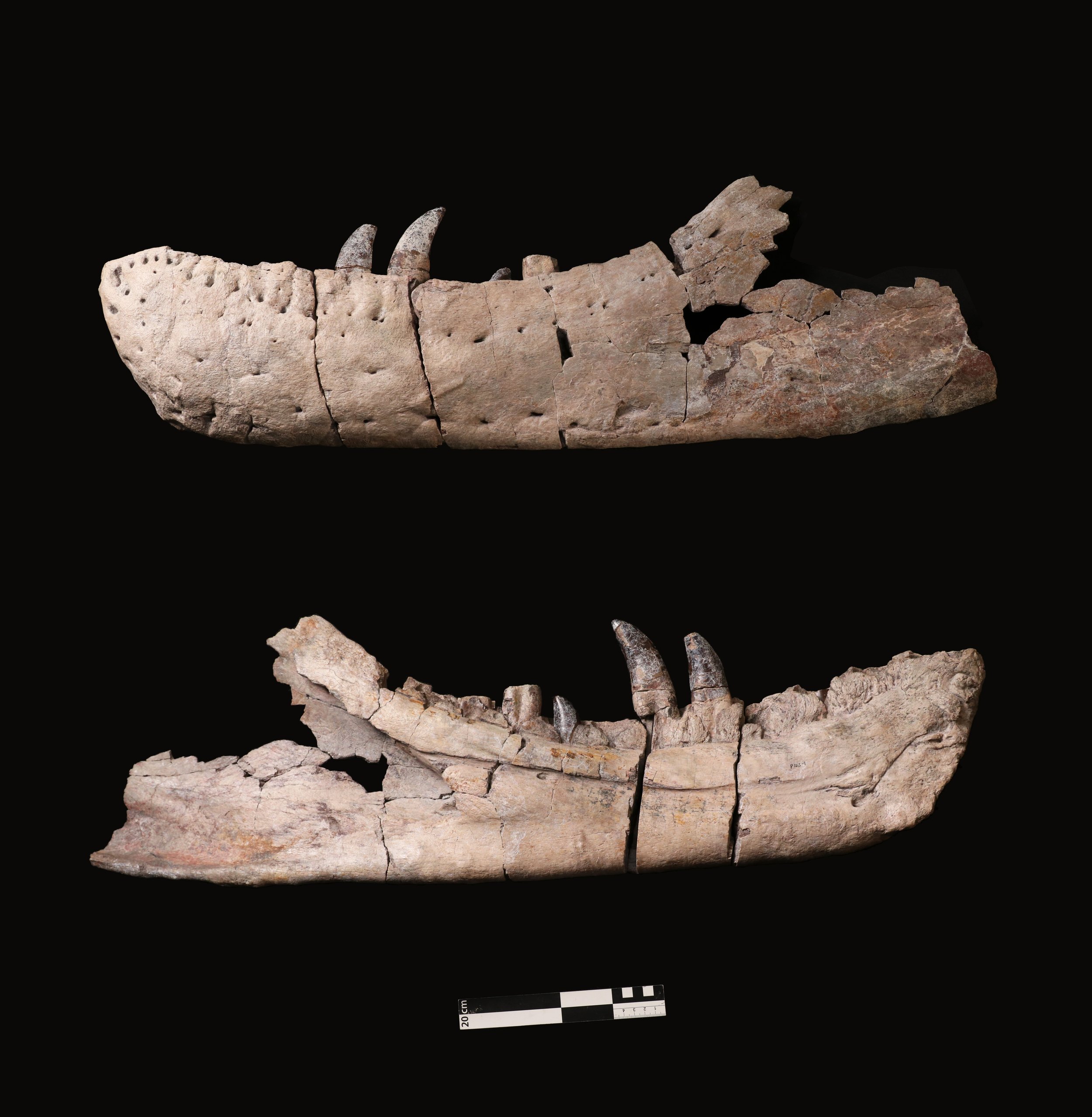
It’s great to see radiometric dates for the Hall Lake tyrannosaur, Tyrannosaurus mcraeensis, which confirm our hypothesis that the animal is much older than any known T. rex.
At 69.4 Ma, NMMNH P-3698 probably predates the T. rex holotype by roughly 3 million years. This is much longer than the stratigraphic range of any dinosaur species I’m aware of, and this provides strong confirmation that T. mcraeensis is a species distinct from T. rex, as the anatomy already tells us.
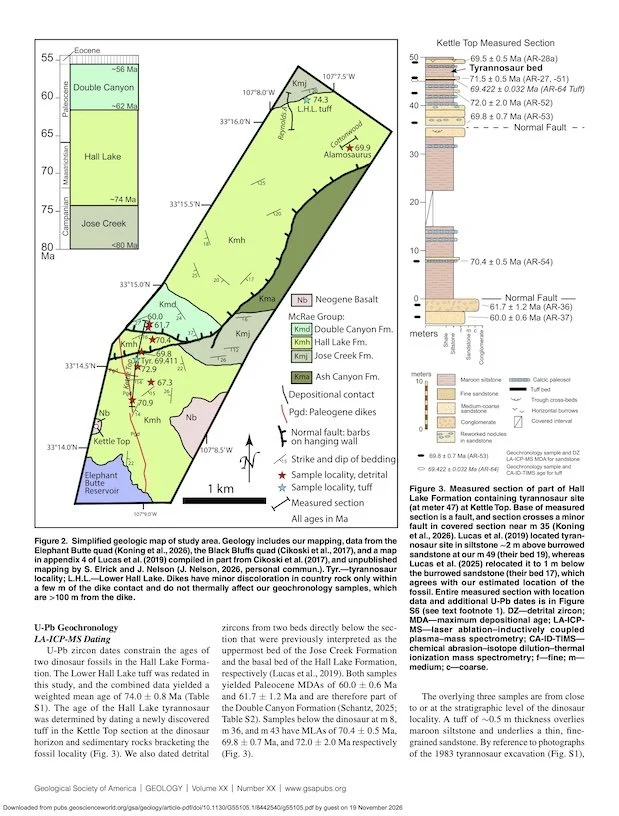
That being said, it’s somewhat disheartening to see the authors repeatedly mischaracterize the conclusions of the manuscript published by my colleagues and I. Their paper repeatedly claims that Dalman et al. (2024) argued that the tyrannosaur is Late Campanian in age. I am unclear how they could get this from reading our paper.
The title of our paper after all is, “A giant tyrannosaur from the Campanian-Maastrichtian of southern North America”; the abstract refers to the “Campanian-Maastrichtian Hall Lake Formation” and in the introduction we describe it as from the “late Campanian—Early Maastrichtian of New Mexico”. In the Horizon and Locality section we report it as “Uppermost Campanian or Lower Maastrichtian”.
You can see what we said in the paper itself, here.
The available evidence all argued against a latest Maastrichtian (Lancian) age, and couldn’t reject either latest Campanian or early Maastrichtian; so that’s what we reported. We provided a rough estimate (more of a guestimate than anything) based on the stratigraphic position, arguing that “Tyrannosaurus mcraeensis may therefore have lived between 72.7 and 70.9 Ma (SI), i.e., latest Campanian or earliest Maastrichtian, 5–7 million years before Tyrannosaurus rex.”
In the absence of radiometric dates for overlying beds, this was obviously not a precise estimate, and we didn’t claim it was. The issue was that the specimen had always been assumed, without evidence, to be latest Maastrichtian; we argued the stratigraphy, paleontology, and the anatomy of the specimen itself argued for latest Campanian/early Maastrichtian.
The new radiometric dates get it about 3 million years younger than T. rex at 66 Ma, so our rough estimate is off by 1.5 million years— but 69.4 Ma is still early Maastrichtian. We did a ballpark estimate using what had been published on the stratigraphy, and we got it in the ballpark.
But interestingly, our tip dating anaysis (which the new Amato et al. 2026 paper failed to mention) gets an age of 69 Ma, which is what we actually showed in our figure:
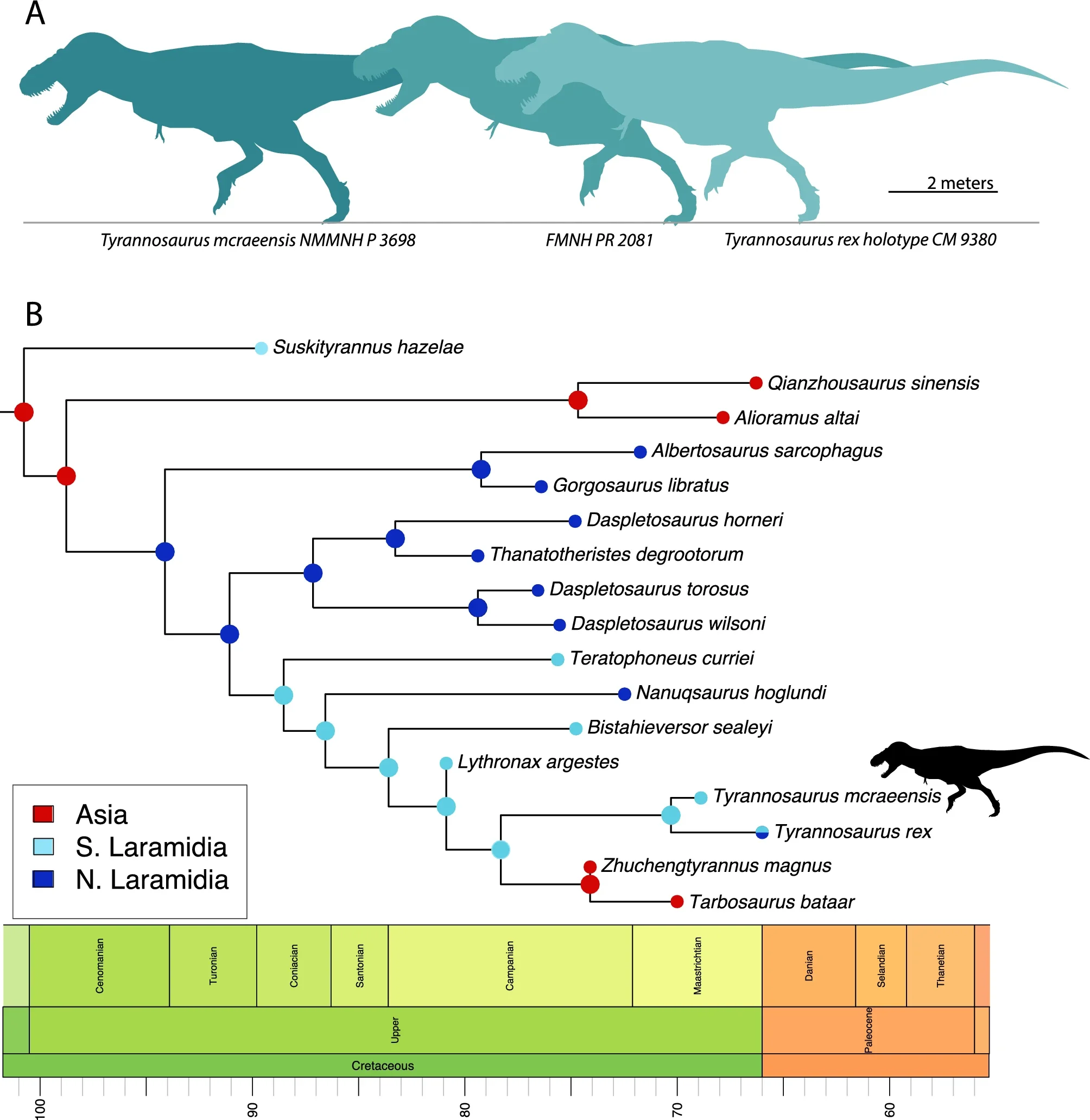
Tip-dated Bayesian analysis from the original paper, showing T. mcraeensis at 69 Ma.
We estimated age several different ways; the one we assumed should be more reliable (a rough estimate of deposition rates) overestimated the age by at least 1.5 million years. Meanwhile, the tip-dating analysis (which hasn’t widely been used to establish the age of fossils) got something that is essentially identical to their radiometric dates; it's right on the money. We didn’t emphasize this age only because tip-dating is a fairly new technique, whose reliability is unknown.
I do try to assume colleagues are acting in good faith, but it’s somewhat difficult to believe that all four authors were so careless that they made the same mistake of repeatedly misreading the paper in the same way, so it looks like a deliberate attempt to mischaracterize our study to make it appear that we were further off than we really were.
Second, and perhaps more importantly, I have to take issue with the idea that an age of 69.4 Ma calls into question our identification of a distinct species of Tyrannosaurus. 3 million years- which is the time separating T. rex at the end of the Maastrichtian from T. mcraeensis in the Early Maastrichtian— is a very long time.
To put it in context, the divergence between leopards and lions is about 3 million years, tigers and snow leopards are separated by 3.5 million years, black bear and polar bear about 3.5 million years. Red fox and arctic fox diverged 3 million years ago, savannah elephant versus forest elephant, 2.5 million years ago.
Among birds (extant dinosaurs), emperor and king penguins diverged 2 million years ago. The entire Darwin's Finch radiation in the Galapagos, with 18 species, is about 2-3 million years old. It is, I would argue, biologically unrealistic to have a species of dinosaur with a stratigraphic range of 3 million years.
Even a million years is a long time for a species. Few species seem to last even a million years, and to the best of my knowledge we have no strong evidence that any dinosaur lasted 3 million years or more.
Everything is constantly evolving- selection is acting in the form of predators, prey, sexual selection in the form of mate choice, diseases, parasites. Climactic warming and cooling and floral turnover all force populations to evolve, constantly. A dinosaur that stopped evolving for 3 million years, well... it would just go extinct.
Tyrannosaurus only lasted for millions of years because it kept evolving to face whatever the environment threw at it, so it produced different species over that time. A Tyrannosaurus that didn’t evolve and speciate wouldn’t have lasted very long.
In this context the debate over taxonomic lumping-versus-splitting isn’t some arbitrary, philosophical, academic debate. Recognizing multiple species acknowledges that species aren’t fixed like the Bible says, but evolve over time as Darwin argued in Origin of Species. Trying to force millions of years of evolution into a single species is, I would argue, fundamentally anti-evolutionary.
We were definitely going out a bit on a limb when we proposed that T. mcraeensis, previously assumed to be late Maastrichtian, was much older than T.rex. We tried to be circumspect and acknowledge the limitations of the data in the absence of precise radiometric dates, and stressed the need for more studies. But now that we have those data, it makes the case for species-level distinction of T. mcraeensis much stronger.
But ultimately, it’s the anatomy that needs to be taken into account, and criticism of T. mcraeensis hasn’t really done this in a scientific way, in my opinion- it’s mostly arm-waving and subjective arguments about how variable T. rex should or shouldn’t be. The thing is, with Tyrannosaurus we actually have a very good sample- one of the best for any dinosaur- and we can look at this variation.
In my opinion, traditional morphometrics are not a very useful tool, but fortunately there’s a much easier and, in my experience, more informative tool at our disposal- which is simple discrete characters like tooth count, presence-absence of discrete characters like foramina, and soforth (these are the sort of characters that are actually used by naturalists and biologists in the field- presence or absence of spots on a bird’s tail, scale counts or gill raker counts in species of salmon).
These presence-absence characters and counts can be coded and its possible to generate a specimen-level, dated phylogeny for Tyrannosaurus to get an idea of how they all relate to one another.
What emerges is pretty interesting(!).
First, Tyrannosaurus mcraeensis splits off from T. rex at around 73 Mya, which is earlier than our previous tip-dating analysis had it. The implication being that giant, T. rex sized animals may have been around in the Campanian. You get slightly different results on divergence time depending on what species you include in the matrix (as this affects the reconstructed evolutionary rates) but as more data is added, it seems to push th rex-mcraeensis split back from early Maastrichtian to latest Campanian.
Second, Tyrannosaurus itself splits into two lineages(!) in the Early Maastrichtian. One of these is your classic T. rex- the holotype, the Scotty specimen from Eastend, and a maxilla from the latest Maastrichtian (c29r) Javelina Formation. This lineage is characterized by a short anterior ramus of the maxilla, a straight squamosal, and an “L”-shaped lacrimal. The precise stratigraphy of the T. rex holotype needs to be better established, however well-dated specimens (Scotty from the Frenchman Formation in Saskatchewan, and the maxilla from the Javelina Formation in Texas) both put the T. rex lineage in the latest, latest Maastrichtian, magnetochron c29r. That’s the final 250,000-400,000 years of the Maastrichtian.
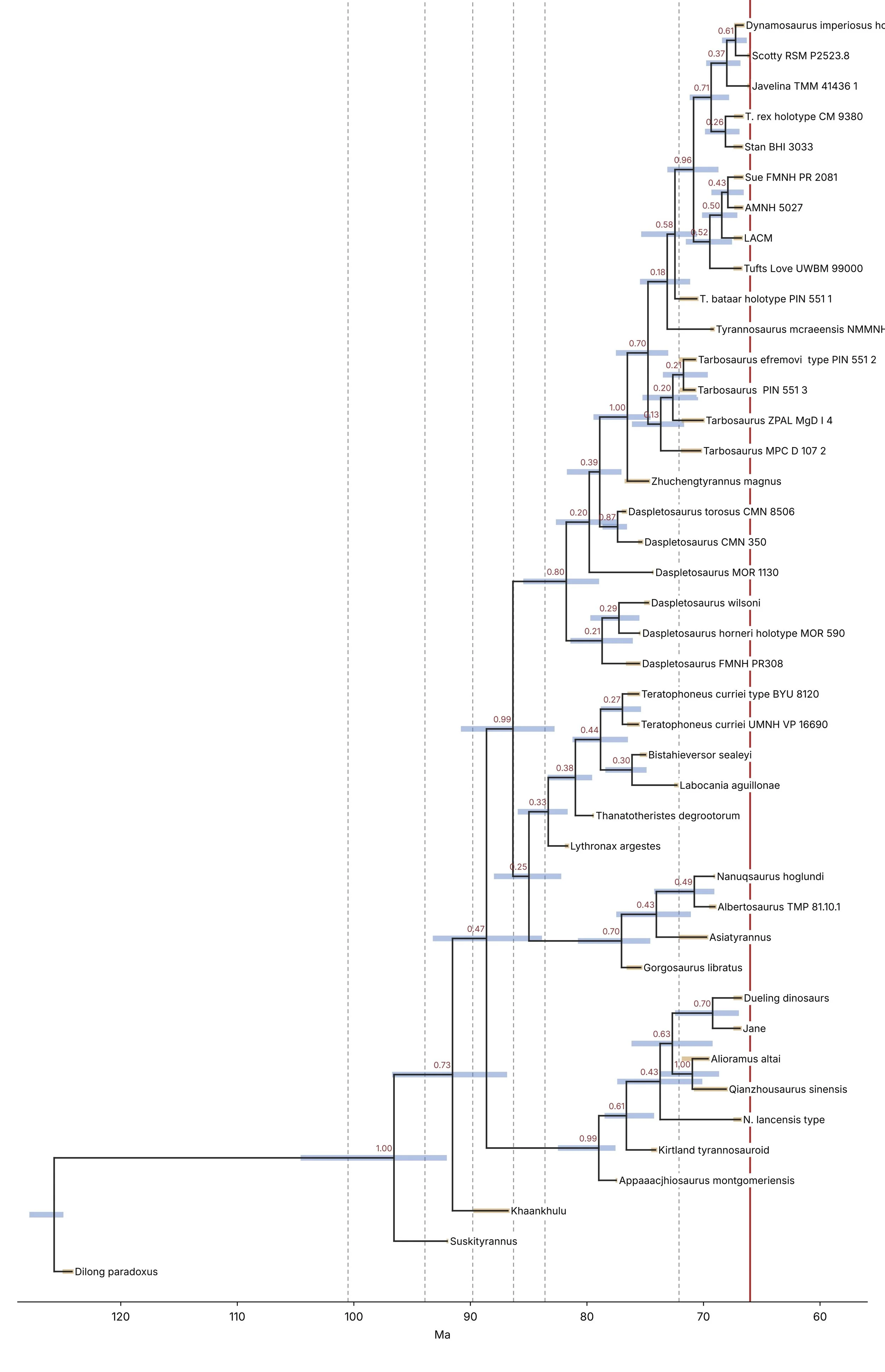
The second lineage includes the famous Sue specimen at the Field Museum and the New York specimen, AMNH 5027, and the Tufts-Love specimen at University of Wyoming. This lineage is characterized by a more long and low anterior ramus of the maxilla, a “7”-shaped lacrimal, and a bent squamosal.
I’ve previously noted a lot of these characters and assumed we might be looking at a grade- a single lineage evolving through time. That’s not how the Bayesian analysis reconstructs it though. These are two distinct lineages, each picking up their own derived features (short anterior ramus of the maxilla and straight squamosal in the holotype lineage; hooked lacrimal in the Sue/AMNH 5027 lineage).
The classic T. rex lineage may be replacing the Sue lineage, but we don’t really know enough about the stratigraphy of these things to be certain- the detailed stratigraphic studies don’t seem to exist for many of these animals, sadly. So it’s possible both lineages coexisted.
The evidence therefore seems to support the existence of T. imperator (of which Sue is the holotype) as a distinct lineage. I haven’t been able to find a usable description of MOR 555/USNM 555000 (=T. “regina”) in the literature or even decent photos (for all the fuss tyrannosaur paleontologists make when a T. rex goes on sale, they unfortunately do not do a very good job of thoroughly describing the material that actually does end up in museums, limiting its value to research).
T. mcraeensis then falls outside this grouping entirely; arguing strongly against it being a variant of T. rex. So that gives us three species.
But there are further oddities. The holotype of T. bataar emerges as sister to the Hell Creek Tyrannosaurus complex(!). That argues that this animal isn’t properly called Tarbosaurus bataar, but is instead Tyrannosaurus bataar— which is what Evgeny Maleev argued all the way back in 1955. It’s not part of Tarbosaurus.
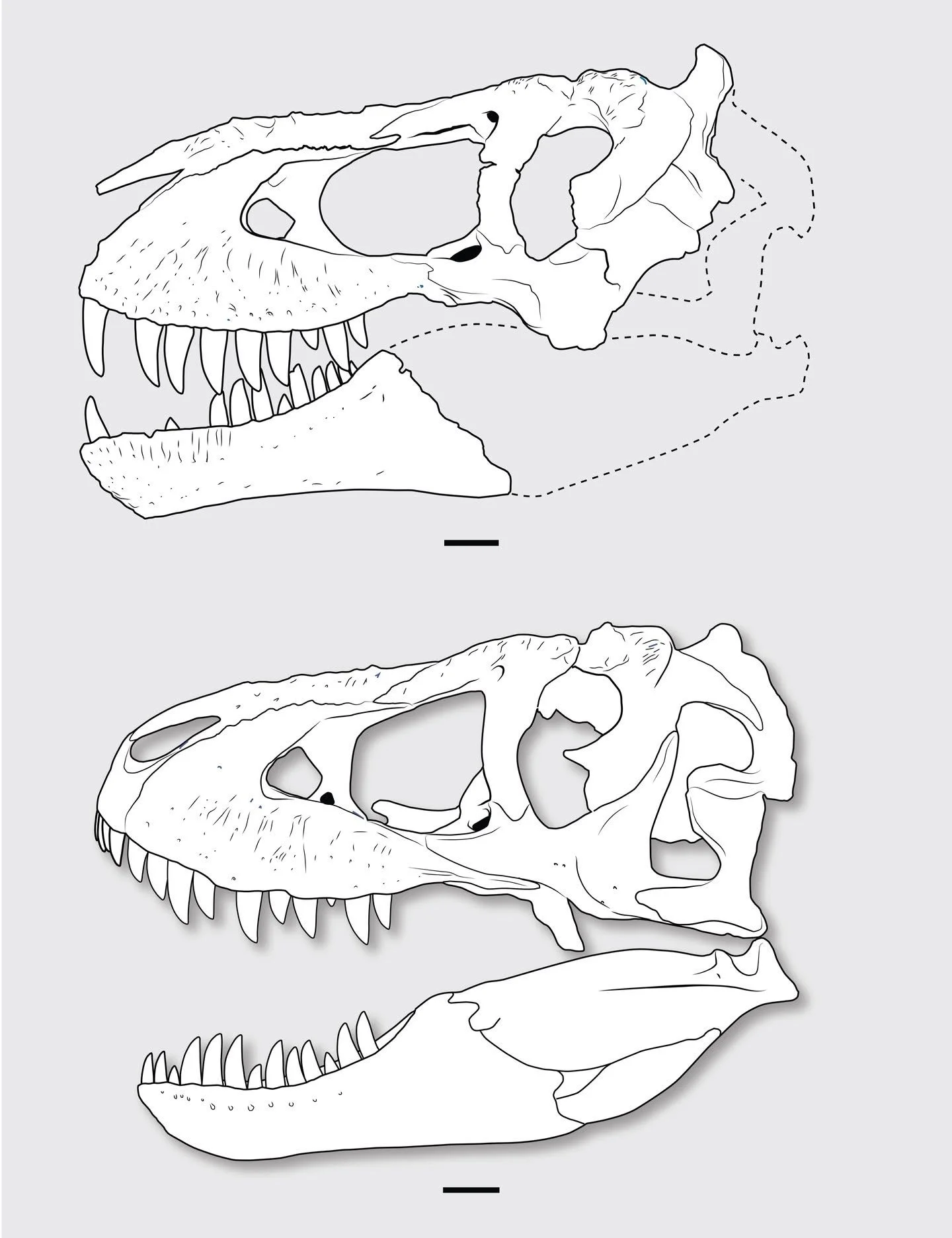
PIN 551-1, holotype of Tyrannosaurus(?) bataar (top) and cf. Tarbosaurus efremovi ZPAL MgD−I/4 (below), both from the Nemegt Formation of Mongolia. Note the different shapes of the rostra, lower jaws, lacrimals, teeth, etc.
Instead Tarbosaurus efremovi is a separate, and more primitive species of Tyrannosaurini, which is distinguished by the shape of the rostrum, arched nasals, etc.
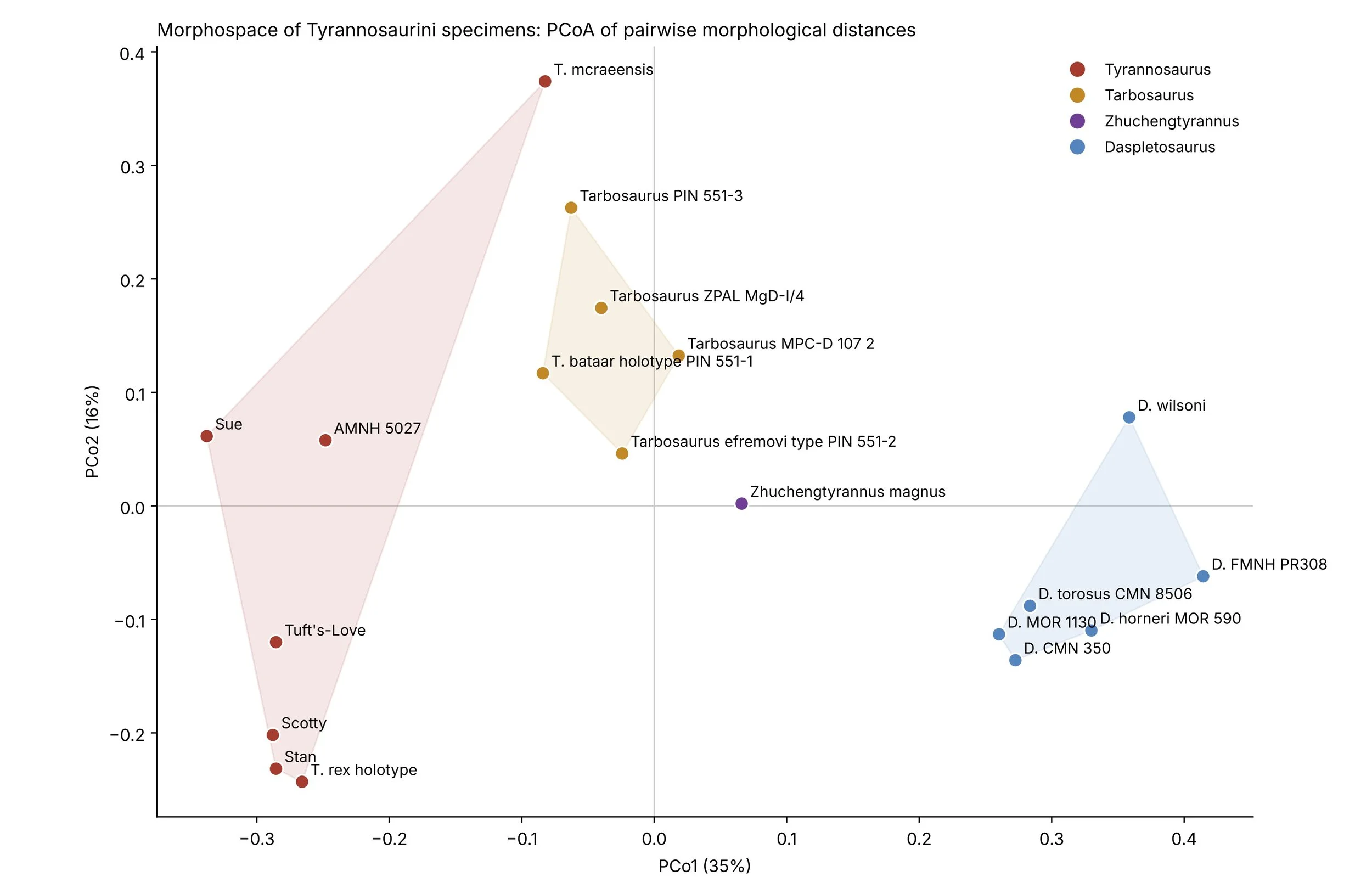
It’s also easy to plot out the data in a morphospace, using PCoA (principle coordinates analysis). What you’ll see is that:
(1), “Tyrannosaurus rex” has a huge spread, much larger than Tarbosaurus or even the three distinct Daspletosaurus species,
(2) T. mcraeensis plots out at the far edge of that space, closer to Tarbosaurus than to Tyrannosaurus rex/imperator.
In terms of overall similarity, it wouldn’t be crazy to put T. mcraeensis in Tarbosaurus instead of T. rex, although the phylogeny argues otherwise.
Another way to visualize the data is a neighbor-joining tree. Here, what you see pretty clearly is that T. mcraeensis is very dissimilar to all the other Tyrannosaurus, and in fact more similar to Tarbosaurus:
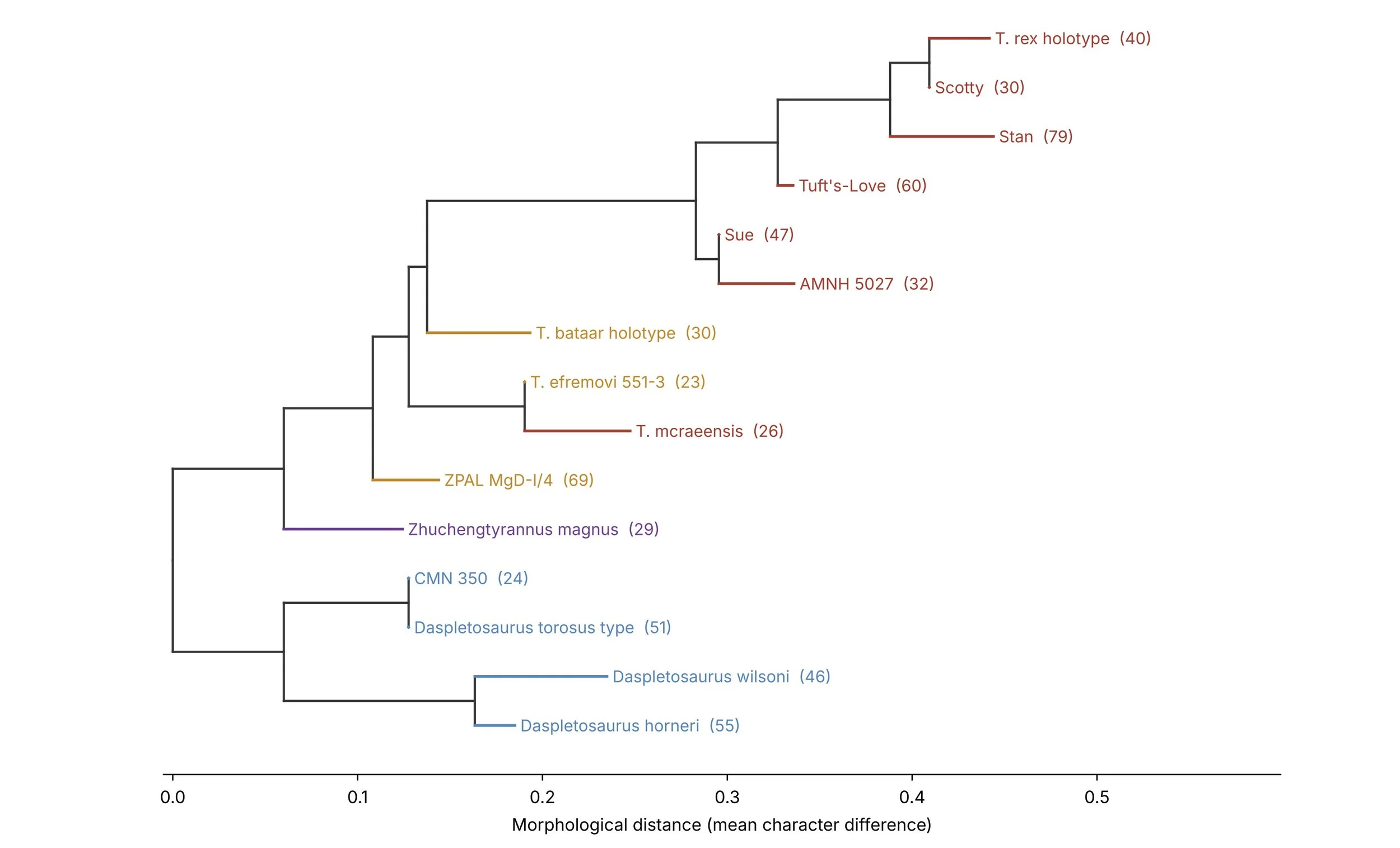
Neighbor-joining isn’t a preferred method for phylogenetics these days, because it groups based on overall similarity, not derived similarity; it measures “sameyness” rather than relatedness (which may or may not be the same thing- animals can be closely related to creatures they don’t closely resemble, the way tetrapods are related to fish).
But neighbor joining is a useful tool because unlike a cladogram it automatically scales branch lengths, it gives you an idea of how similar or dissimilar things are; it’s a good method for data visualization. And it’s super, super fast, unlike other search methods that can take hours, or even days.
So the way to read this is not that T. mcraeensis is automatically part of Tarbosaurus (although I suppose that’s not absolutely impossible, and at least some of the Bayesian trees get that) but rather that it’s an anatomical outlier that looks more Tarbosaurus-like than Tyrannosaurus-like in a lot of ways, arguing strongly against putting it in T. rex.
These are very quick-and-dirty analyses, mind you. I spent a couple days putting together a dataset (it’s still a work in progress) and it still needs more specimens, data, and characters added to fill out the dataset, so the results may change (some species go in different places in the tip-dating analysis than the parsimony analysis, for example).
But it also illustrates that there are scientific ways to get at these issues- rather than just bluster, arm-waving and the Appeals to Authority of self-appointed Tyrannosaur Experts- we can actually analyze the data. Which, in all the years of arguing about Tyrannosaurus species, almost nobody has ever actually bothered to do before, it seems.
The issue it seems, is not that there is in fact “Insufficient Evidence for Multiple Species of Tyrannosaurus in the Latest Cretaceous of North America” but rather, that there is lots and lots of evidence and it just hasn’t been studied properly.
Here and in other taxonomic debates, people have just asserted that, based on Expert Opinion, a species is/is not valid, that certain variation can be dismissed as individual variation/ontogeny/sexual dimorphism etc.: Tyrannosaurus is all one species, Tyrannosaurus bataar and Tarbosaurus efremovi are the same thing, etc.
These conclusions are frequently asserted based on limited evidence and/or subjective judgments, rather than backed up by any sort of objective analysis. In short, these arguments are not very scientific.
And in the case of T. rex, they have taken on an almost cult-like atmosphere, insofar as there are certain things you are and are not allowed to believe to remain in good standing with the cult leaders. With certain issues in paleontology, it seems one is expected to agree and obey, not to think, and not to look at evidence.
As things stand, the data- radiometric dates, character evidence, phylogenetics, morphometrics- argue that Tyrannosaurus mcraeensis is distinct from any other Tyrannosaurus, and that even the variation seen in “Tyrannosaurus rex” exclusive of the Hall Lake specimen is markedly larger than what is seen in other tyrannosaurine genera, like Daspletosaurus and Tarbosaurus. The data seem to suggest that T. rex itself represents two lineages- T. rex itself, and T. imperator. And maybe T. bataar is actually part of the Tyrannosaurus clade, not part of Tarbosaurus and all.
Could these results be wrong? Sure. But we make progress in science by throwing out ideas and testing them, rather than by suppressing dissenting ideas.
I don’t have a dog in this fight, in the sense that I haven’t previously staked out a position on the rex/imperator question in print to defend, and I really don’t care that much what the answer ends up being… just so long as that answer is rooted in the evidence. I’m okay with putting everything in one species, if that’s what the evidence says.
The thing is, that is not what the evidence I have seen says, at least the moment.
Could this change? Of course, the scientific process is about gathering additional evidence to test hypotheses.
My point isn’t that one or two analyses mean we can now definitively state that Tyrannosaurus is four species (T. rex, T. imperator, T. mcraeensis, T. bataar), and end the debate forever. Rather, my point is that we should actually have a serious scientific debate. Statements of how many species the fossils represent are scientific hypotheses and if we are to be scientists, and if dinosaur paleontology really is to be a serious science rather than a hobby for enthusiasts, we need to actually test these hypotheses against the data, rather than just making assertions.
References
Carr, T.D., 2025. Observations on the skull of the type specimen of Tyrannosaurus rex Osborn, 1905. All Earth, 37(1), p.2539638.
Carr, T.D., Napoli, J.G., Brusatte, S.L., Holtz Jr, T.R., Hone, D.W., Williamson, T.E. and Zanno, L.E., 2022. Insufficient evidence for multiple species of Tyrannosaurus in the latest Cretaceous of North America: A comment on “The Tyrant Lizard King, queen and emperor: Multiple lines of morphological and stratigraphic evidence support subtle evolution and probable speciation within the North American genus Tyrannosaurus”. Evolutionary Biology, 49(3), pp.327-341.
Carr, T.D., Williamson, T.E., 2000. A review of Tyrannosauridae (Dinosauria, Coelurosauria) from New Mexico. New Mexico Museum of Natural History and Science Bulletin 17, 113-145.
Dalman, S.G., Loewen, M.A., Pyron, R.A., Jasinski, S.E., Malinzak, D.E., Lucas, S.G., Fiorillo, A.R., Currie, P.J. and Longrich, N.R., 2024. A giant tyrannosaur from the Campanian–Maastrichtian of southern North America and the evolution of tyrannosaurid gigantism. Scientific Reports, 14(1), p.22124.
Hurum, J.H. and Sabath, K., 2003. Giant theropod dinosaurs from Asia and North America: skulls of Tarbosaurus bataar and Tyrannosaurus rex compared. Acta Palaeontologica Polonica, 48(2).
Longrich, N.R., Dalman, S., Lucas, S.G. and Fiorillo, A.R., 2026. A large tyrannosaurid from the Late Cretaceous (Campanian) of North America. Scientific Reports, 16(1), p.8371.
Maleev, E.A., 1955. Doklady, Academy of Sciences USSR 1955, 104 (4): 634-637. GIANT CARNIVOROUS DINOSAURS OF MONGOLIA. In Doklady, Academy of Sciences USSR (Vol. 104, No. 4, pp. 634-637).
Paul, Gregory S., W. Scott Persons IV, and Jay Van Raalte. "The tyrant lizard king, queen and emperor: Multiple lines of morphological and stratigraphic evidence support subtle evolution and probable speciation within the North American genus Tyrannosaurus." Evolutionary Biology 49, no. 2 (2022): 156-179.
Voris, J.T., Zelenitsky, D.K., Kobayashi, Y., Modesto, S.P., Therrien, F., Tsutsumi, H., Chinzorig, T., Tsogtbaatar, K., 2025. A new Mongolian tyrannosauroid and the evolution of Eutyrannosauria. Nature, 1-7.