Update on Xenodens
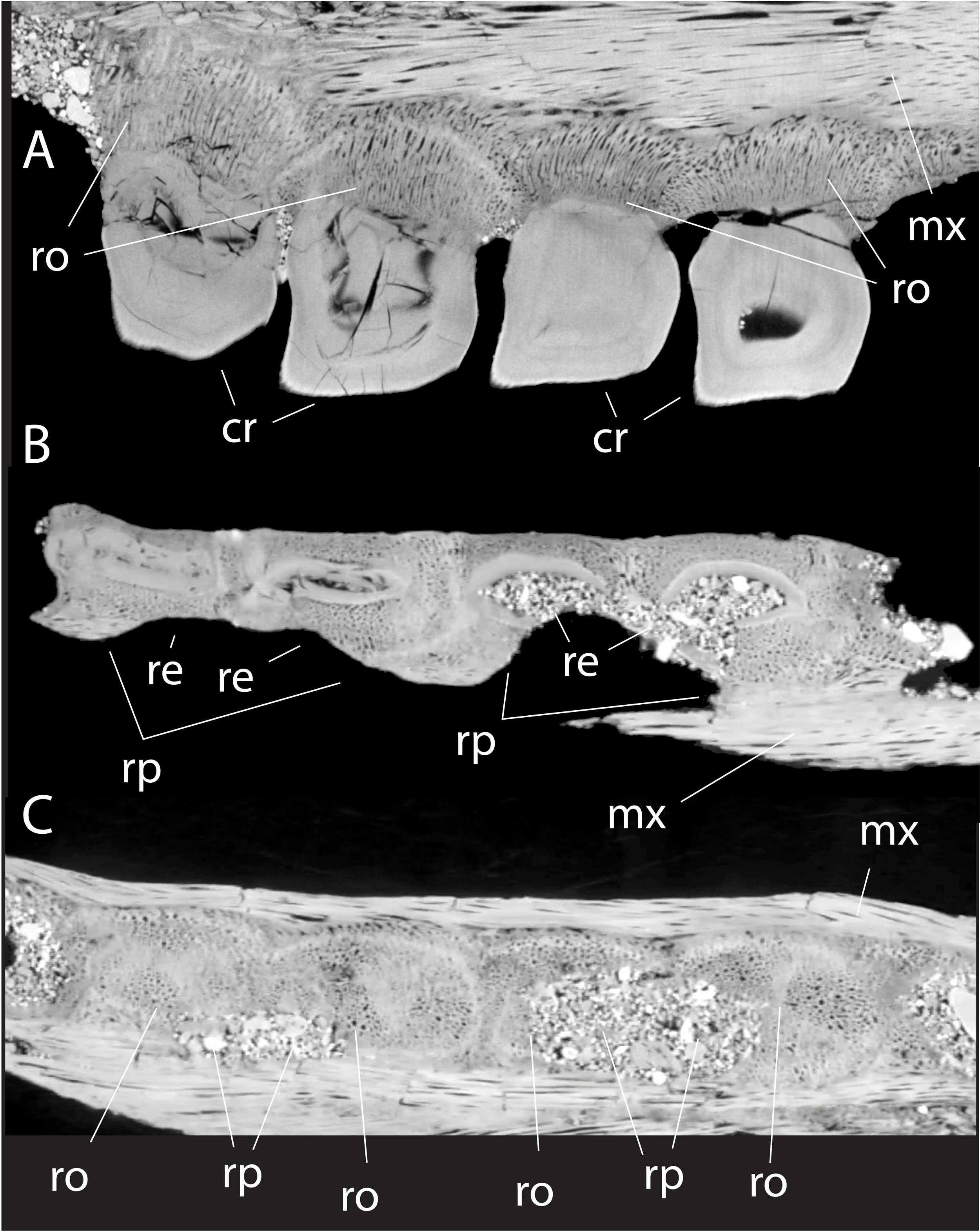
CT scans of the holotype of Xenodens calminechari
A new paper has now been published on the strange mosasaur Xenodens calminechari in the journal Diversity; the manuscript is available here.
CT scans of the holotype and a new, referred specimen confirm the anatomical interpretations from the original description of Xenodens, and furthermore show a modified form of tooth replacement. Posterior teeth implanted into a groove in the jaw, and replacement pits of adjacent teeth merging to form a large replacement pit. It is possible that the teeth were shed in pairs.
The unusual tooth structure, implantation and replacement in Xenodens underscore the remarkable evolutionary experimentation in mosasaurs at the end of the Cretaceous.
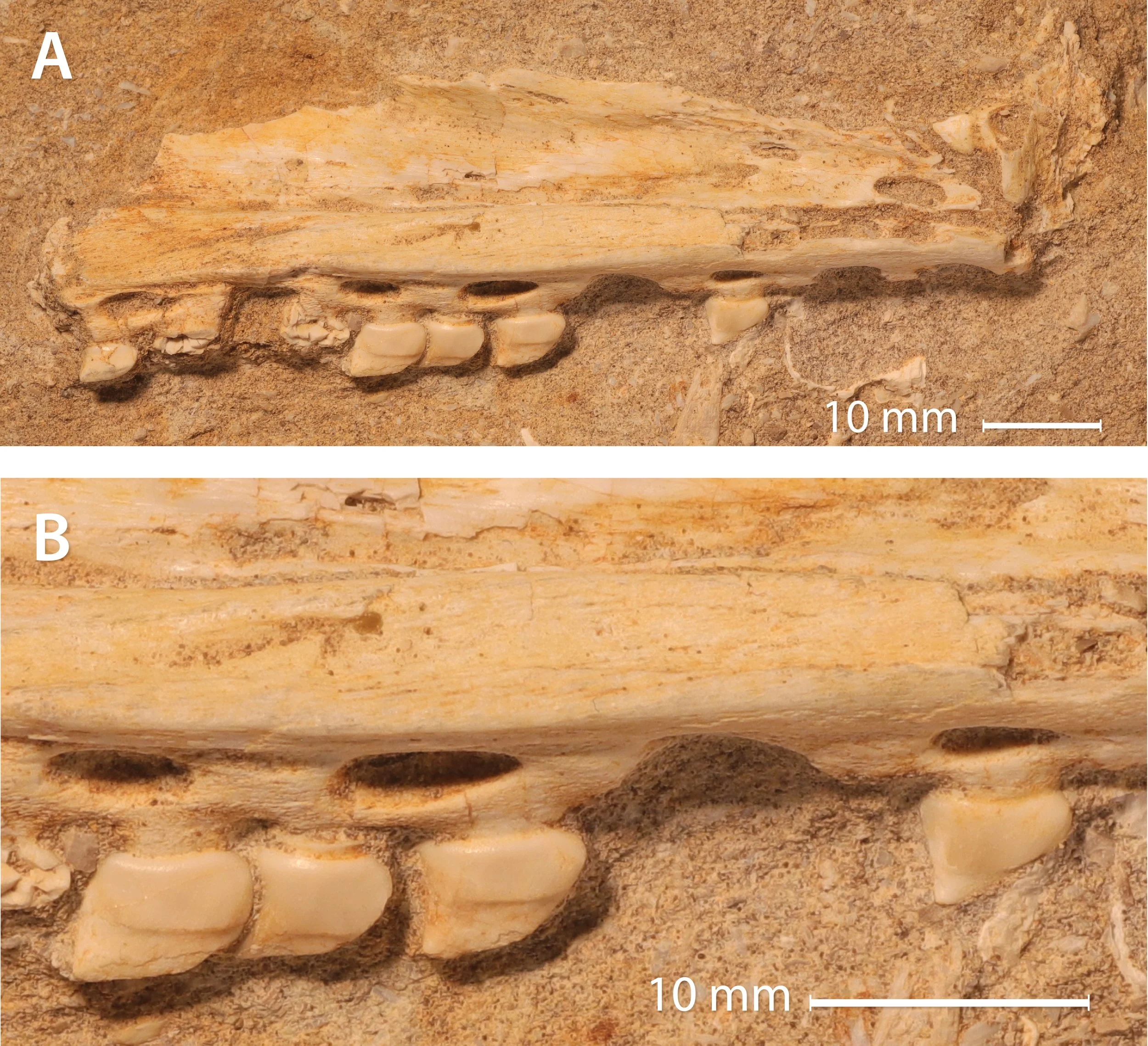
Referred maxilla of Xenodens
The relationships of Xenodens remain a mystery. It originally seemed that the tooth proportions suggested affinities with Carinodens. However new material now under study hints that Xenodens is a deep-diverging lineage of Mosasaurinae, possibly related to Clidastes, which would be interesting as it would show this lineage survived up to the K-Pg boundary. Carinodens meanwhile has a highly specialized forelimb suggesting affinities with Mosasaurus and Plotosaurus, so they seem to lie in completely separate parts of the mosasaur tree. These new specimens still need preparation and further study, however.
Xenodens is truly a bizarre animal. But as Mark Twain put it, fiction has to be believable, reality is under no such constraint. Something worth remembering when working on fossils and evolution.
The late Maastrichtian phosphates of Morocco are one of the most remarkable records of marine vertebrates known, not just from the late Cretaceous, but any time in Earth’s history. They also appear to have been deposited during a period of extraordinary diversity. They were deposited in a marine biodiversity hotspot— after many years, we’re still just beginning to describe the diversity of mosasaurs, plesiosaurs, turtles, fish, and dinosaurs in the phosphates. And the beds are exceptionally rich, with vast bonebeds full of teeth, isolated bones, associated and articulated skeletons stretches for tens of kilometers. The phosphates have produced a lot of surprises— the tube-snouted turtle Ocepechelon, the little duckbill dinosaurs Ajnabia and its relatives Minqaria and Taleta, Xenodens— and it will doubtless continue to challenge our ideas about evolution as we do more work on this exceptional fossil fauna.
Scan data and associated files will be made permanently available on Morphosource; in the meantime files are available on Dropbox here.
References
Bardet, N., Fischer, V., Jalil, N.-E., Khaldoune, F., Yazami, O.K., Pereda-Suberbiola, X., Longrich, N., 2025. Mosasaurids Bare the Teeth: An Extraordinary Ecological Disparity in the Phosphates of Morocco Just Prior to the K/Pg Crisis. Diversity 17, 114.
Martens, B.P., Rempert, T.H., Rempert, T.H., Franklin, B.K.B., Marson, K.M., 2025. Frontoparietal morphology of Xenodens calminechari revealed by a new specimen from the Maastrichtian phosphates of Morocco, Western Association of Vertebrate Paleontology 2025 Annual Meeting.
Longrich, N.R., Bardet, N., Khaldoune, F., Yazami, O.K., Jalil, N.-E., 2021. Pluridens serpentis, a new mosasaurid (Mosasauridae: Halisaurinae) from the Maastrichtian of Morocco and implications for mosasaur diversity. Cretaceous Research 126, 104882.
Longrich, N.R., Bardet, N., Schulp, A.S., Jalil, N.-E., 2021. Xenodens calminechari gen. et sp. nov., a bizarre mosasaurid (Mosasauridae, Squamata) with shark-like cutting teeth from the upper Maastrichtian of Morocco, North Africa. Cretaceous Research 123, 104764.
Longrich, N.R., Jalil, N.-E., Khaldoune, F., Yazami, O.K., Pereda-Suberbiola, X., Bardet, N., 2022. Thalassotitan atrox, a giant predatory mosasaurid (Squamata) from the Upper Maastrichtian Phosphates of Morocco. Cretaceous Research 140, 105315.
Longrich, N.R., Jalil, N.-E., Pereda-Suberbiola, X., Bardet, N., 2023. Stelladens mysteriosus: A Strange New Mosasaurid (Squamata) from the Maastrichtian (Late Cretaceous) of Morocco. Fossils 1, 2-14.
Longrich, N.R., Suberbiola, X.P., Pyron, R.A., Jalil, N.-E., 2021. The first duckbill dinosaur (Hadrosauridae: Lambeosaurinae) from Africa and the role of oceanic dispersal in dinosaur biogeography. Cretaceous Research 120, 104678.
Longrich, N.R., Pereda-Suberbiola, X., Bardet, N., Jalil, N.-E., 2024. A new small duckbilled dinosaur (Hadrosauridae: Lambeosaurinae) from Morocco and dinosaur diversity in the late Maastrichtian of North Africa. Scientific Reports 14, 3665.
Longrich, N.R., Pereda-Suberbiola, X., Bardet, N., Jalil, N.-E., 2025. A new hadrosaurid dinosaur from the late Maastrichtian Phosphates of Morocco provides evidence for an African radiation of lambeosaurines. Gondwana Research.