A Response to a Recent Critiques of the Hunter Wash Tyrannosaur
Thoughts on Carr's comments in this New Scientist article — why his critiques don't hold up.
Quotes from the article below and my responses follow:
1. “These are pretty unbelievable claims about a single bone that’s not well preserved,” says Thomas Carr, a paleontologist at Carthage College in Kenosha, Wis.,”
The idea that the ancestors of Tyrannosaurus existed in the late Campanian is hardly extraordinary. Zhuchengtyrannus, one of T. rex’ closest relatives, occurs in the late Campanian of China, at roughly the same time as the Hunter Wash animal. That means that the lineage leading to Tyrannosaurus had already split off and must have existed at the same time, or earlier— Zhuchengtyrannus implies a ghost lineage leading into the late Campanian. We also have Tyrannosaurus-sized tyrannosaurs in the Javelina Formation of Texas at approximately 69 mya, and T. mcraeensis around 71-73 mya in New Mexico, suggesting a southern Laramidian origin of Tyrannosaurus. The Hunter Wash tibia therefore appears precisely when and where we expect the lineage leading to Tyrannosaurus rex.
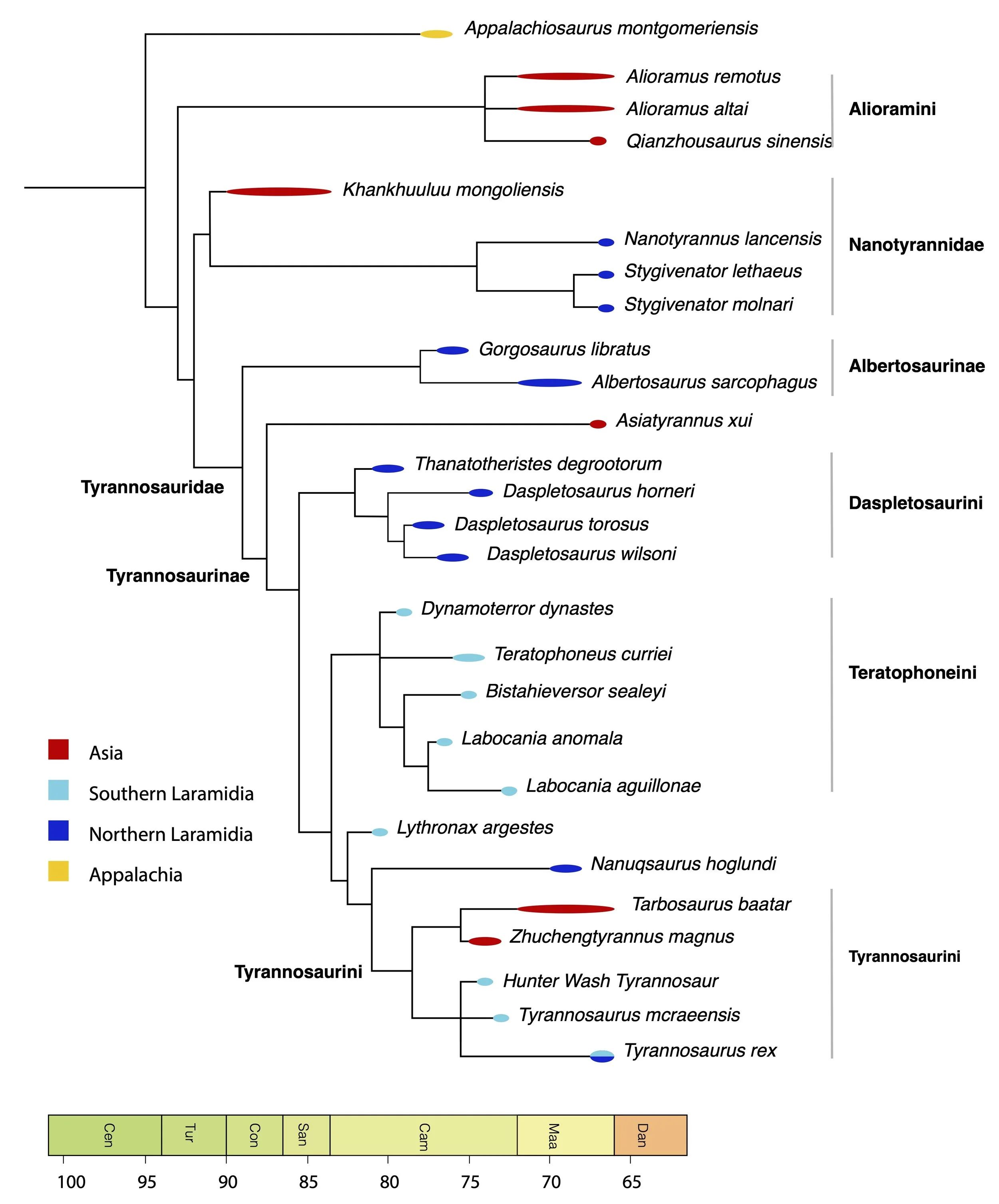
The existence of Zhuchengtyrannus in the late Campanian implies that the Tyrannosaurus lineage is at least as old.
2. “In my view, the null hypothesis is that the tibia is from a large and heavy Bistahieversor, since no other tyrannosaurids are known from that geological unit.”
However, the assumption that there is only one tyrannosaur in the formation is precisely what needs to be tested: this argument assumes what we first need to prove. In fact, well-sampled formations typicallly have two (Nemegt, Dinosaur Park Formation) tyrannosaurs or even more (Hell Creek/Lance have at least three distinct lineages), so arguably the starting assumption should be multiple tyrannosaurs, not one.
3. “they have not demonstrated convincingly that the similarities between that tibia and those of tyrannosaurids is not simply the consequence of large size.”
The differences cannot simply be due to size because we have tyrannosaur tibiae that are similar in length that lack these features. Lambe (1917) gives the length of the tibia+astragalus in the holotype of Gorgosaurus libratus NMC 2120 as 1000 mm, versus 960 mm for the tibia of the Hunter Wash specimen, NMMNH P-25085.
There are also smaller tibiae that are never the less straight and robust: Tarbosaurus PIN 551-2, with a tibia length of 850 mm (Maleev 1955), is actually significantly smaller than the Gorgosaurus type, but it has a robust, straight tibial shaft, again showing that these features are not simply the consequence of large size.
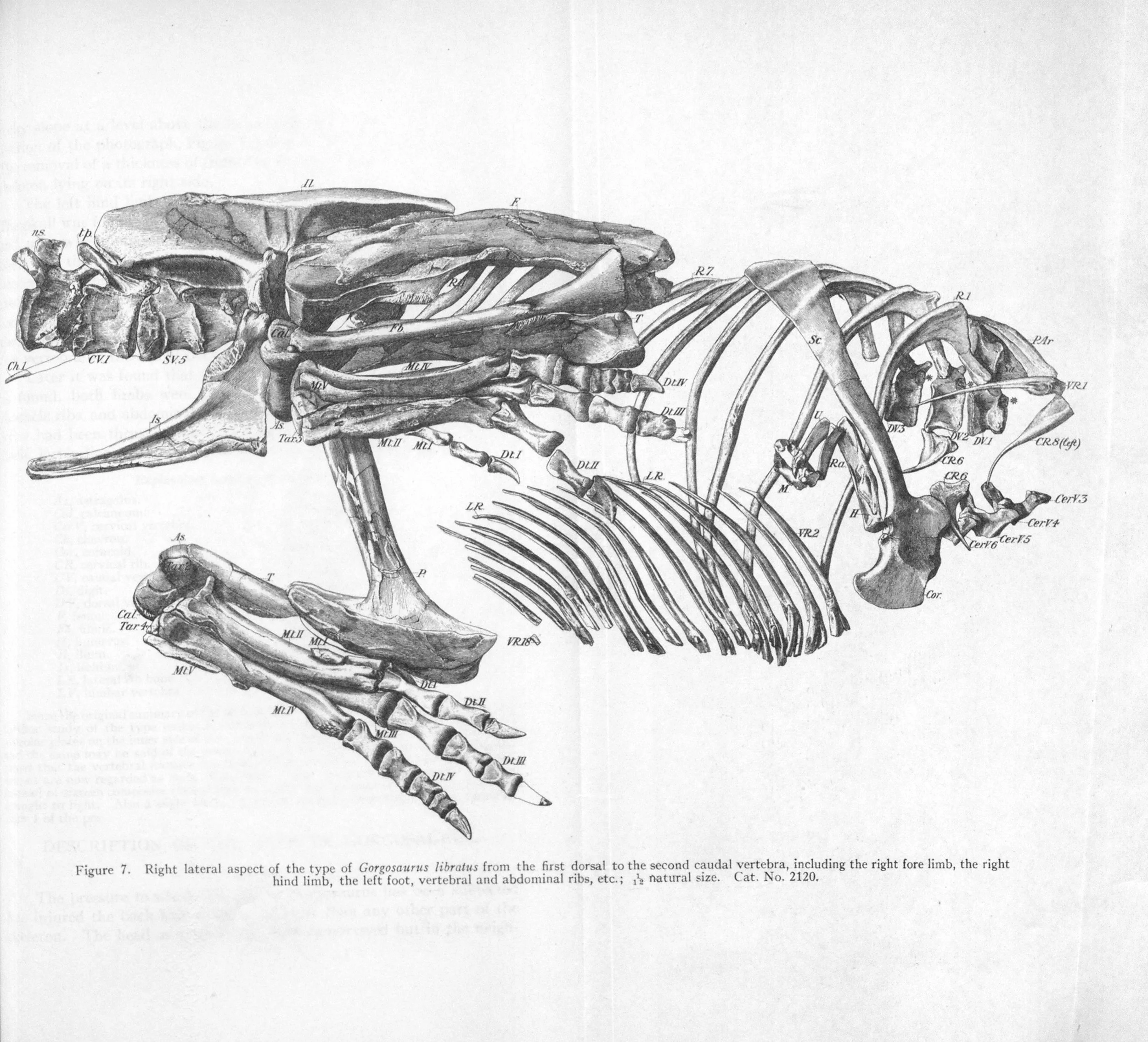
The holotype of Gorgosaurus libratus, CMN 2120, has a tibia 100 cm in length, but it is slender, bowed, and lacks a strongly expanded distal end- showing these features are not purely the result of large size.
4. The leg bones of juvenile tyrannosaurids such as T. rex are known to be markedly different from adult leg bones, in that they’re thinner and more bowed... “Functionally, [these creatures are] all the same: They run around killing things then get old and big and walk around killing things.”
The smallest definitive T. rex is LACM 23845. The tibia is present, but broken distally (Molnar, 1980), it cannot be assessed, but the metatarsals suggest the limbs were overall very robust even at small size. All other “juvenile T. rex” with limb material are now known to be Nanotyrannus (Jane, Dueling Dinosaurs, etc.). We simply do not know what juvenile T. rex tibia looks like, but as noted above, we do have examples of large, adult tyrannosaurs that lack the robust, straight morphology, whereas even small T. rex seem to be very robust. It's simply not accurate to say that they all have the same limb proportions. The Hunter Wash tyrannosaur is genuinely different from what would expect for a basal tyrannosaur.
In short, Carr seems to be starting with the assumption that there is only one tyrannosaur in the Kirtland Formation and working backwards from there, rather than treating this idea as a hypothesis to be tested.