How many Pachycephalosaurus species are there?
Late Maastrichtian pachycephalosaurs are probably more diverse than we’ve assumed
Pachycephalosaurus wyomingensis is both the largest of the Pachycephalosauridae, and one of the last and most specialized members of the family. The skull is around two feet (64 cm) long and bears a massive dome formed by the frontals and parietals. The swollen appearance of the head gives the appearance of a huge brain, but that domed structure is not a braincase, but the thickened roof of the skull. The dome is a solid mass of bone about 8-10 inches thick that sits on a small lump of brain. The back of the skull bears a series of low, button-shaped knobs, and the snout bears a series of conical hornlets. Pachycephalosaurus probably used these huge, thickened heads to fight, ramming each other head-on like bighorn sheep, cape buffalo and musk oxen. We don’t have good skeletons for these animals, but the skeletons of related animals like Prenocephale suggest surprisingly stocky limbs, they probably weren’t that fleet-footed. The olfactory bulbs on these things are enormous, so one wonders if they could have been nocturnal.
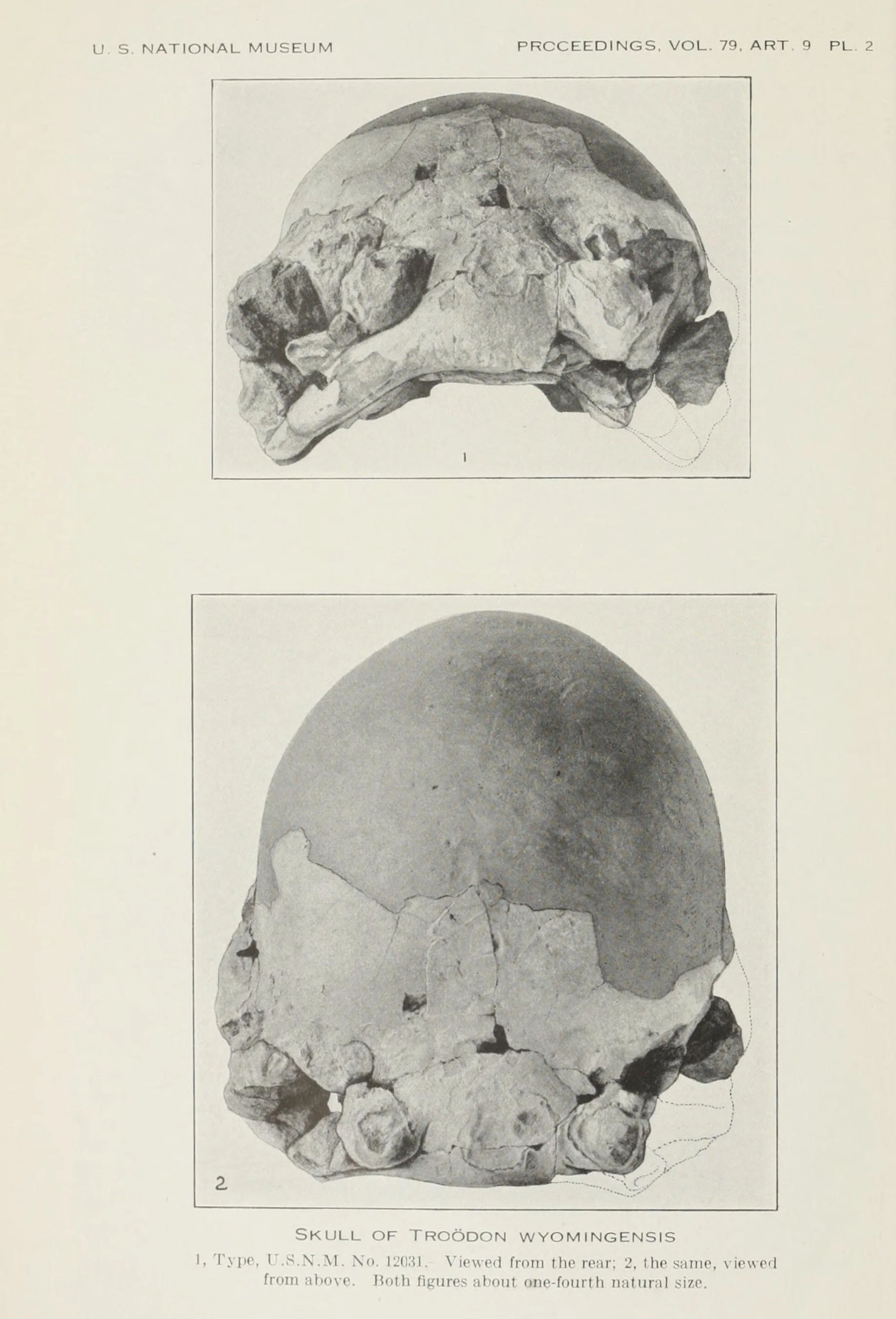
The original “Troodon” wyomingensis skull roof described by Gilmore in 1931, USNM 12031. Note the broad area lacking ornament on the back of the skull: this turns out to be important.
The genus Pachycephalosaurus has a long and tortured taxonomic history.
Based on similarities between the teeth of pachycephalosaurs and Troodon, the animals were originally assigned to the Troodontidae, which were originally recognized on the basis of teeth alone. The animal we now know of as Pachycephalosaurus wyomingensis was originally described by Gilmore in 1931, as Troodon wyomingensis.

In 1943, Brown and Schlaiker would describe AMNH 1696, a virtuallly complete skull, as a new genus and species, Pachycephalosaurus grangeri. P. grangeri and Troodon wyomingensis were later recognized as the same species. So the species name “grangeri” was sunk but the generic name stuck, so the animal is now known as Pachycephalosaurus wyomingensis (one of the longer dinosaur names out there, at 33 letters and 12 syllables).
Pachycephalosaurus reinheimeri
Curiously, Brown and Schlaikjer named a second species for their new genus, Pachycephalosaurus reinheimeri, based on CM (Colorado Museum) 469. P. reinheimeri has generallly been considered to be the same thing as P. wyomingensis, but there are some very striking differences.
Brown and Schlaiker diagnose their P. reinheimeri as follows:
“Frontoparietal area very low, broad, and shallow. Prominent parietosquamosal shelf, with the posterior margin nodose and medially deeply notched. Frontals low and narrow where in contact with the nasals.”
The most obvious difference is the shape of the dome, which is unusually low and broad compared either to P. wyomingensis, or other pachycephalosaurs like Prenocephale, or even primitive pachycephalosaurs like Stegoceras.
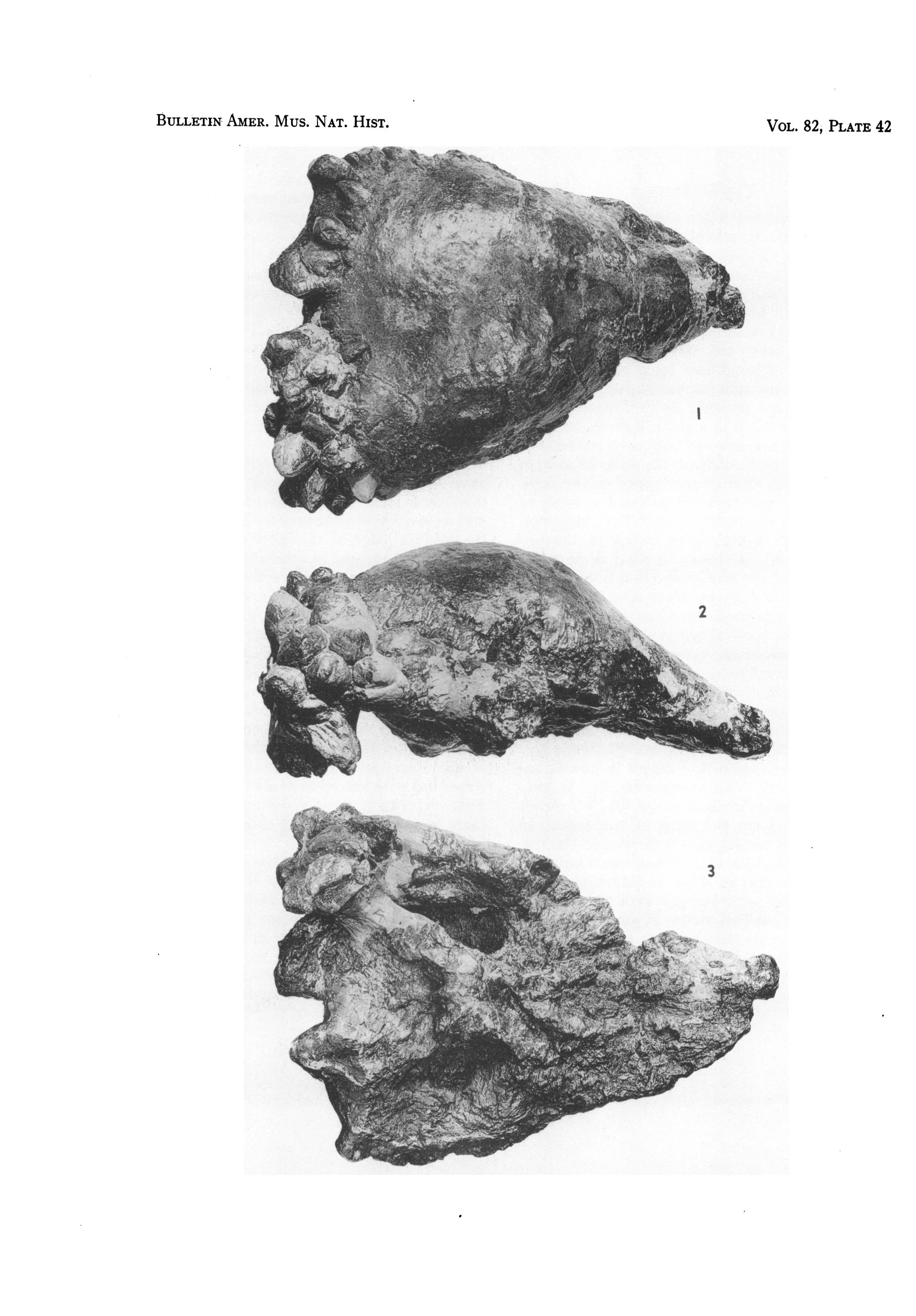
It’s really a pretty extreme morphology. The other really striking difference involves the ornament- the nodes/hornlets extends across the entire back of the skull (the parietosquamosal shelf) with only a slight gap between the nodes along the midline (the “notch”). Having the ornament extend across the entire parietosquamosal shelf isn’t actually that odd- we see it in, for example, Alaskacephale, Prenocephale, Sphaerotholus and Stegoceras. But we don’t have it in P. wyomingensis: here the ornament is restricted to the corners of the skull, with a big gap between the hornlets at the back of the skull (a feature shared, interestingly, with Stygimoloch) so there’s no “notch”.
Lest you think the reinheimeri morphology is a one-off, there’s a second specimen, CM 3180 that shows the exact same combination of characters: an extremely low, broad dome, and multiple rows of ornament extending across the entire back of the skull:
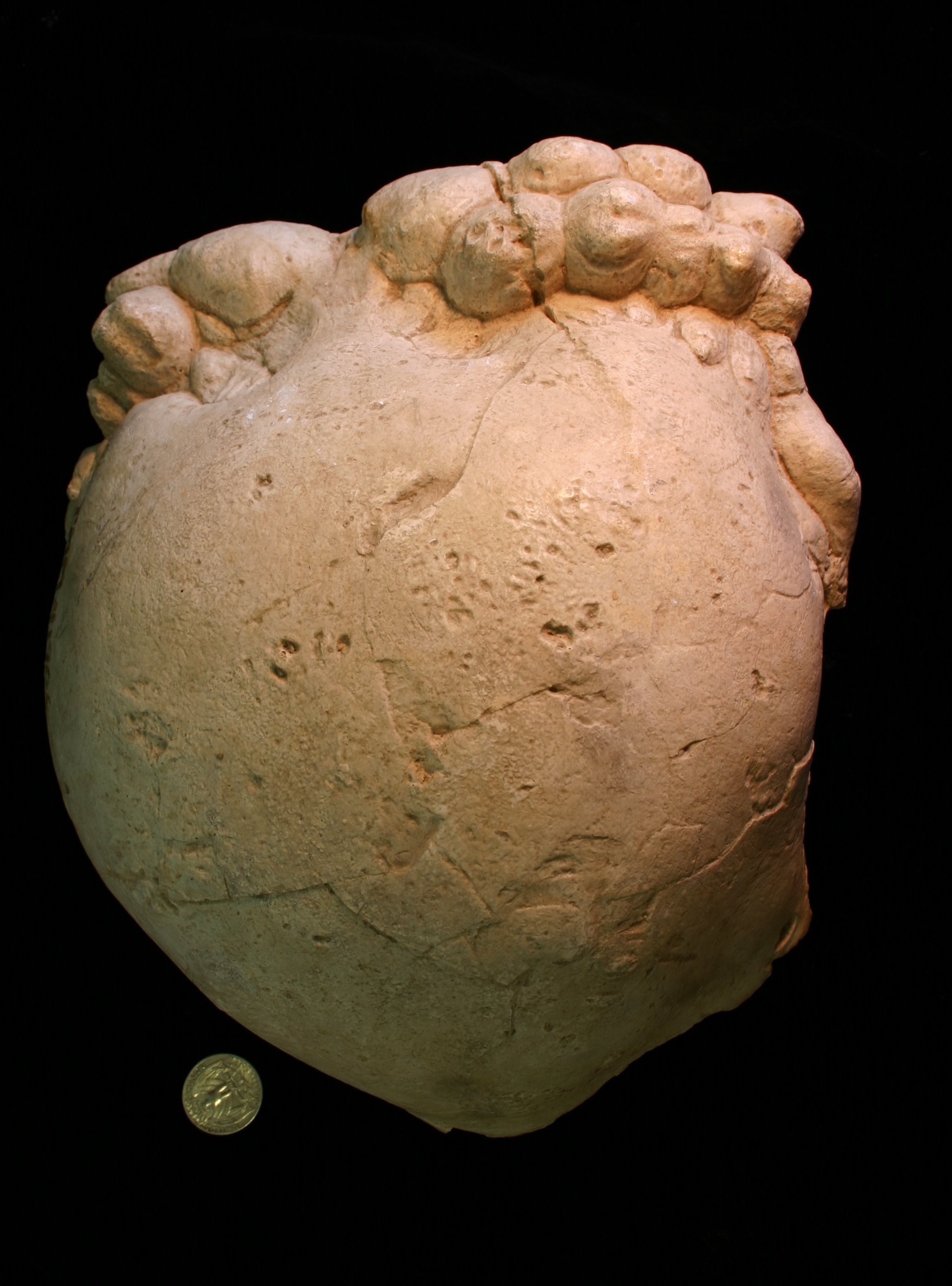
There are some subtle differences in the hornlet morphology but overall it’s pretty close to the holotype of P. reinheimeri.
You can also find photographs online of a reinheimeri-like dome (minus the distinctive ornament) that went up for sale in an auction a few years ago.
Now, dome characters are tricky. We know from Stegoceras that within a single species, you can have fully domed forms, half-domed forms, and flat-headed forms.
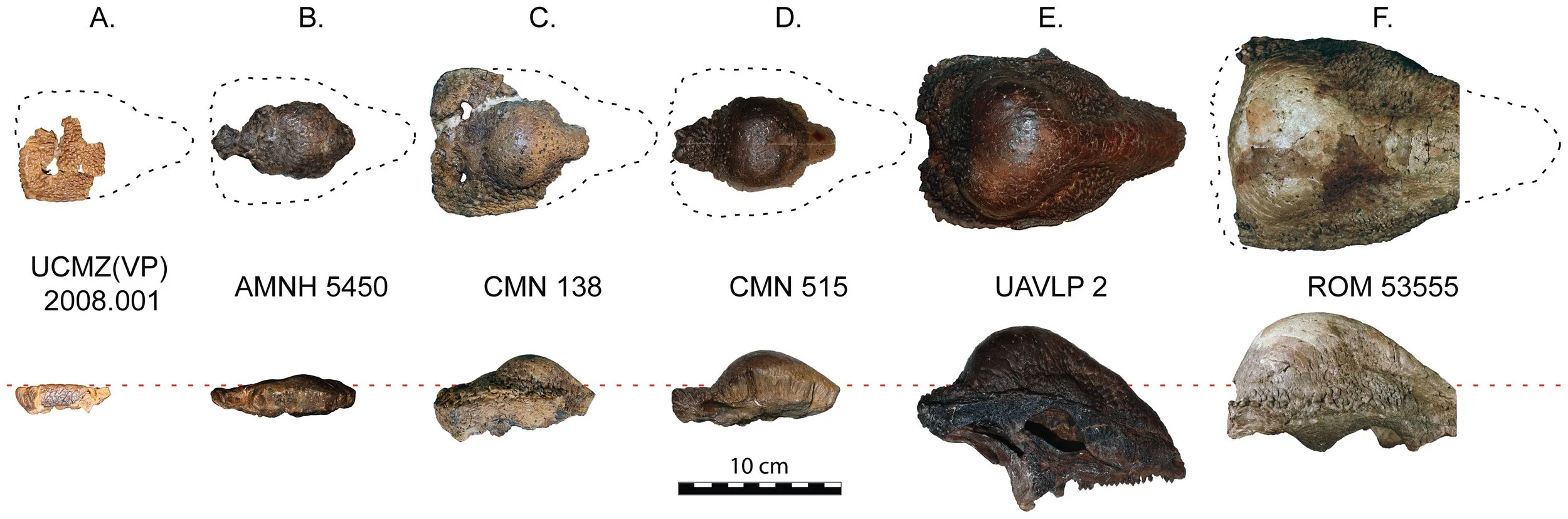
Domes seem to form as the animals get bigger, and it’s not impossible there’s sexual dimorphism too. But both P. reinheimeri and P. wyomingensis are big animals, and neither do they show obvious signs of immaturity like an open frontoparietal suture or the numerous foramina and rugose frontoparietals seen in immature pachycephalosaurs.
Ornament- the knobs, or nodes, or hornlets, or whatever you want to call them- is different from the dome. It’s actually far more diagnostic. That’s because the knobs/nodes/hornlets are bony structures but they seem to have formed in association with scales, like the hornlets in modern horned toads, or the bony tubercles seen on the surface of the skull in various lizards such as gila monsters and Xenosaurus.
What Lizard Scales Tell Us About Dinosaur Species
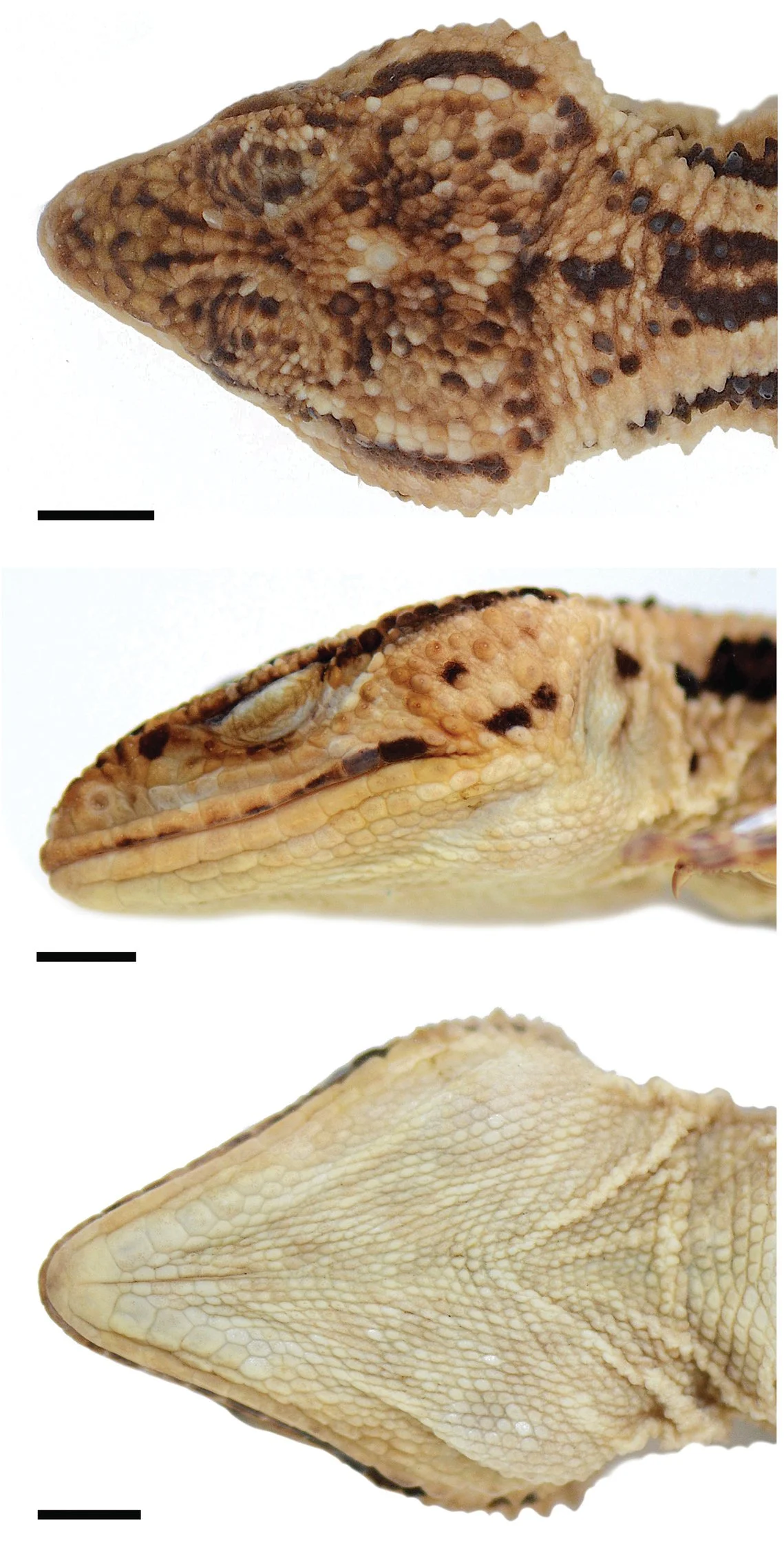
Xenosaurus, showing scales.
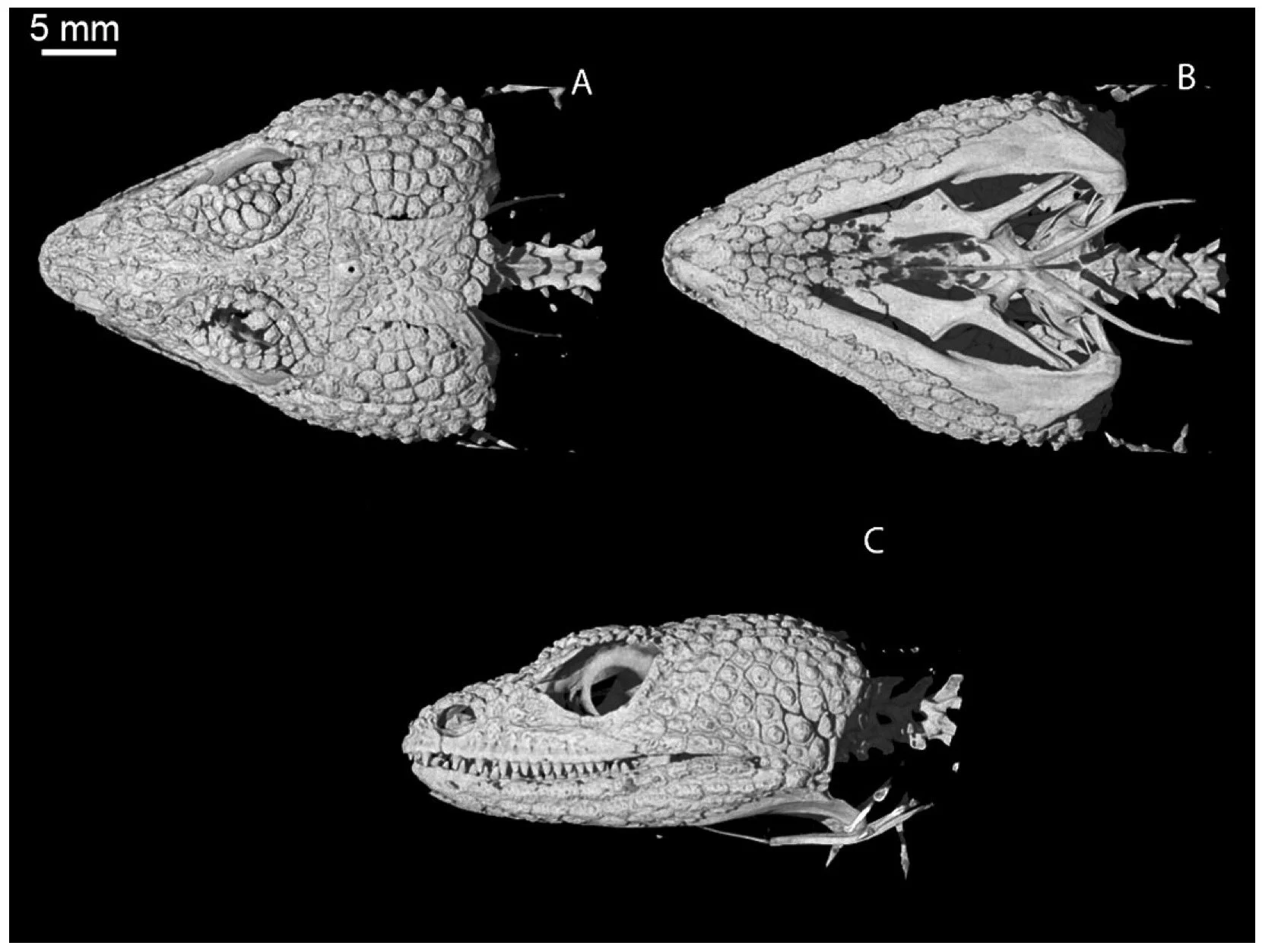
Xenosaurus, showing osteoderms in dermis and fused to skull, each associated with a scale.
As you can see in this Xenosaurus, the scaly pattern we see on the frontal and parietal bones is actually formed by osteoderms- bony elements formed in association with the scales- which fuse to the surface of the skull. You’re seeing the soft tissue patterns expressed on the surface of the skull. And it turns out these scalation patterns are hugely taxonomically informative.
For one, scalation patterns tend to be highly variable between species. Here, for example, are horny toads, Phrynosoma, which show different scalation patterns in different species. We see that there are different scale patterns in different species- not just the large parietosquamosal spikes/scales, but the small tubercles of the frontals and parietals. These are all different species, distinguished (in part) by subtle and not-so-subtle differences in the ornament:
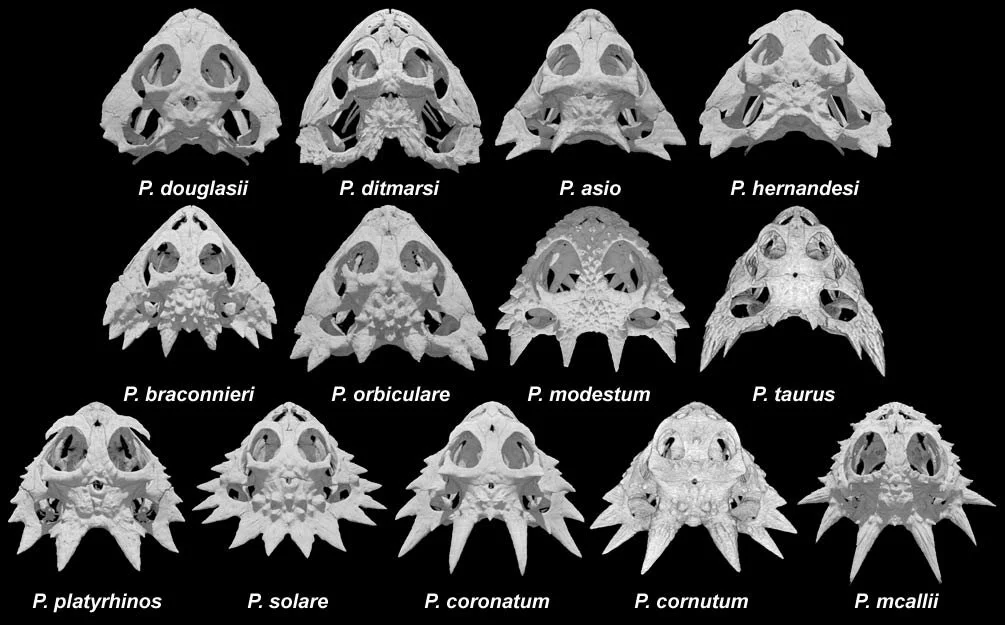
Different species of the horned lizard Phrynosoma, showing the distinct arrangements of scales that diagnose each species.
But it gets better. The scales aren’t just taxonomically informative, they’re ontogenetically stable; the numbers and arrangements of scales generally don’t change as animals age.
Now, given that scales are soft tissues it might seem a bit surprising that they can actually be more stable over the course of development than bones. But scales initially form in the embryo, so an animal hatches out with as many scales as they will ever have. The precise number and arrangement of scales can and does vary a bit from individual to individual, and the osteoderms and associated scales can get larger and change shape, but they generally don’t gain or lose them as they get older, and the arrangement stays stable, as we see here in a growth series for Phrynosoma:
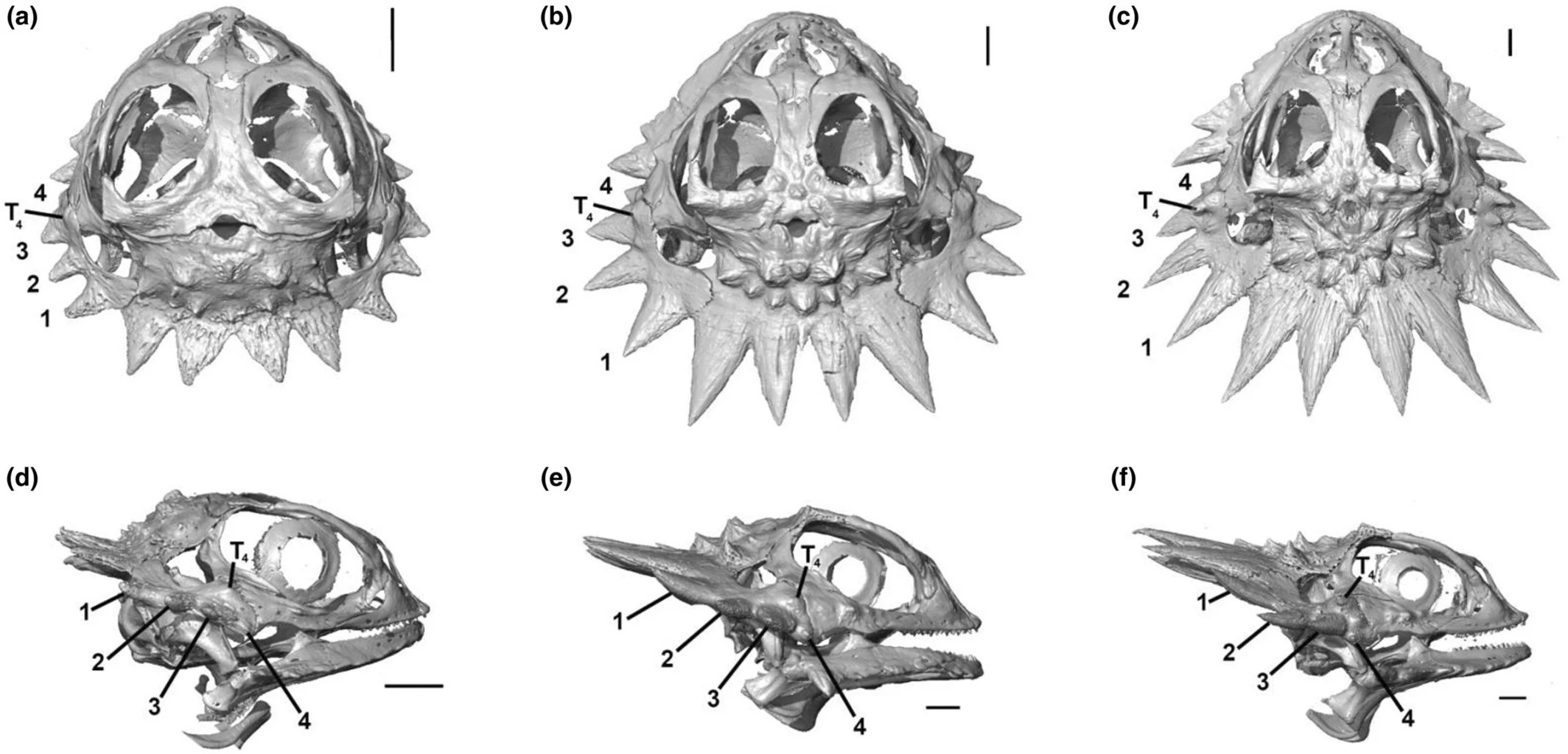
Developmental series of the horned toad Phrynosoma cornutum, showing how osteoderms enlarge- but don’t change number or orrangement- with age.
Humans have an analogous situation with our integumentary patterning: our fingerprints.
Babies skulls change massively as they grow grow, but fingerprints don’t. That’s why people rely on fingerprints when babies are born, rather than photographs of their faces, to keep a unique identifier of the baby which can be used throughout life.
As a result, scales are super useful in taxonomy- both in living and fossil species.
Diagnoses of fish often use scale counts, and likewise diagnoses of living snakes and lizards rely heavily on characters like the scales of the lip and forehead; likewise crocodilians can be identified to species based on the scalation pattern of the scutes on the neck. The precise number of scales can vary from individual to individual (or even between the left and right side of the same individual) but there’s often a species average that differs between species, and since the numbers don’t change with age, different numbers of scales can’t reflect adults versus juveniles.
So counterintuitively, the superficial structures of the ornament turn out to be phenomenally useful in the taxonomy of pachycephalosaurs (nodes), ceratopsians (epioccipital bones), ankylosaurs (scutes and cranial scales) and soforth.
And in this specific case, the fact that P. wyomingensis and P. reinheimeri have very different patterns of ornament cannot be due to ontogeny.
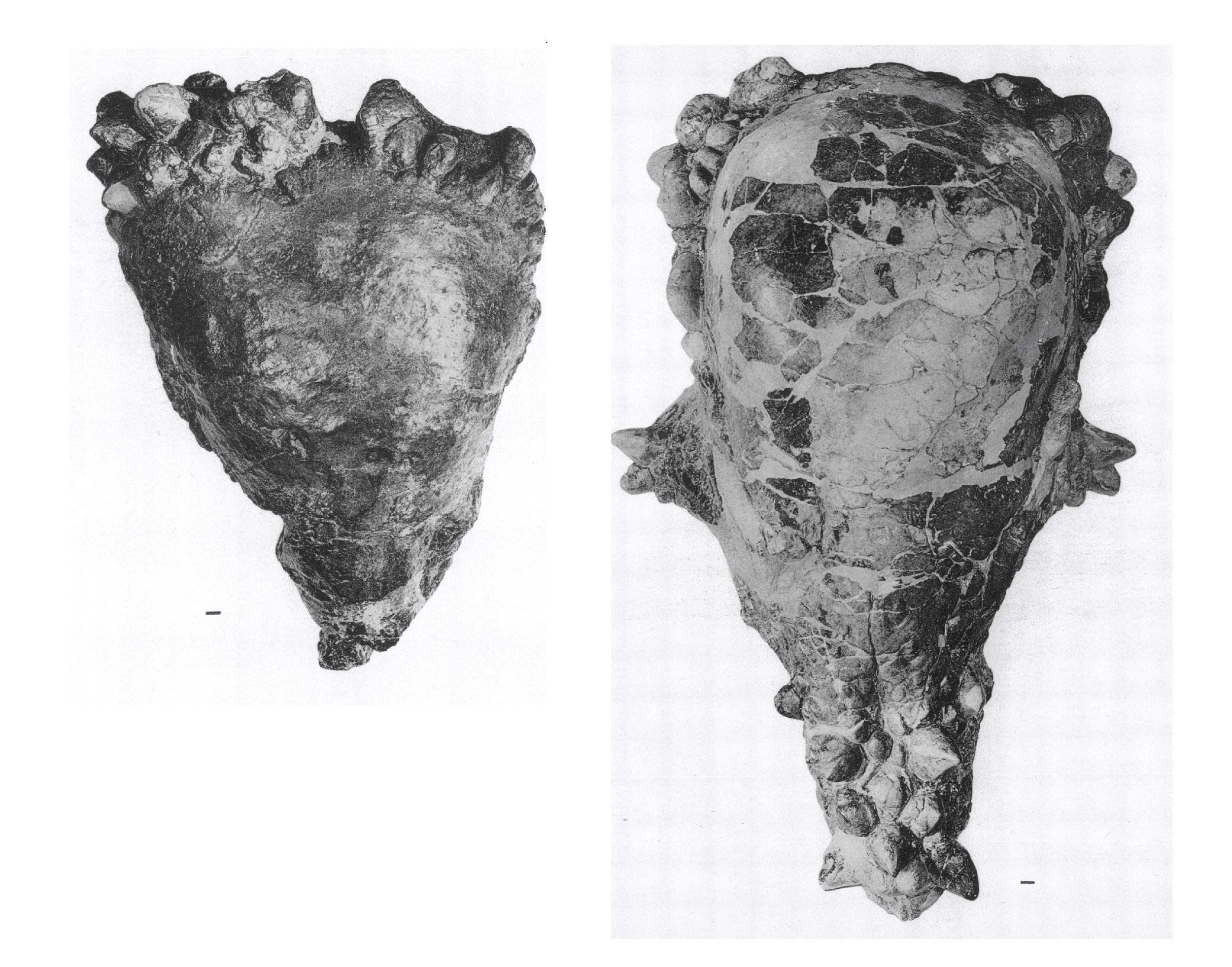
Now, it could in theory be due to individual variation, but I seriously doubt it- the differences are pretty massive (as large or larger than the differences between our various horned lizard species, for example). This suggests they’re separate species.
So two species; P. wyomingensis and Pachycephalosaurus reinheimeri?
Well… not so fast.
Remember that P. wyomingensis seems to have its ornament on the corners of the skull, and in a sort of rosette arrangement? There’s another creature that shows the same thing: Stygimoloch spinifer. This is a derived feature- a specialized character not seen in primitive pachycephalosaurs like Prenocephale or Sphaerotholus- which suggests the two may share a common ancestor. The two could be sister-taxa: the reduced dome in Stygimoloch is a derived feature, so it does not preclude a sister-taxon relationship with the big-domed Pachycephalosaurus (yes, I am aware Stygimoloch has been proposed to be a juvenle Pachycephalosaurus, and no, I do not think there is much in the way actual evidence or rigorous scientific studies to support such an hypothesis).
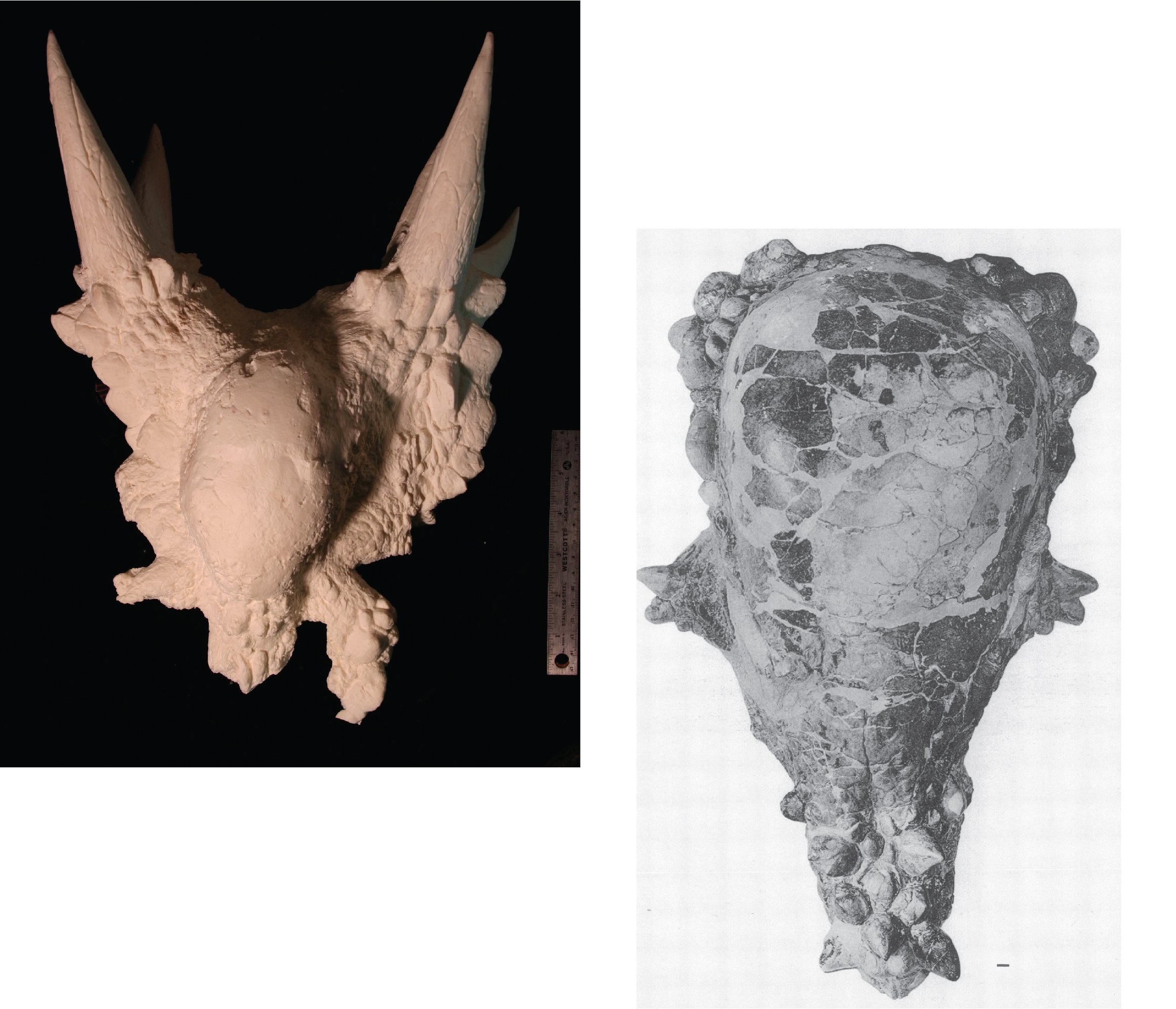
Stygimoloch spinifer compared with Pachycephalosaurus wyomingensis.
P. reinheimeri, meanwhile, shows nodes in multiple rows across the back of the skull, extending to the midline of the skull. This actually looks more like Alaskacephale. So if I had to guess, P. reinheimeri is primitive relative to those two, and actually the sister to a Pachycephalosaurus-Stygimoloch clade. This is of course pretty speculative given we lack good skulls of these things, but then, we have to start somewhere.
One more complication. A couple of years ago, a dome was describe as a new pachycephalosaur, “Platytholus clemensi”. It unfortunately doesn’t preserve the highly diagnostic squamosal ornament. It does have a halfway decent dome. So what makes it distinctive?
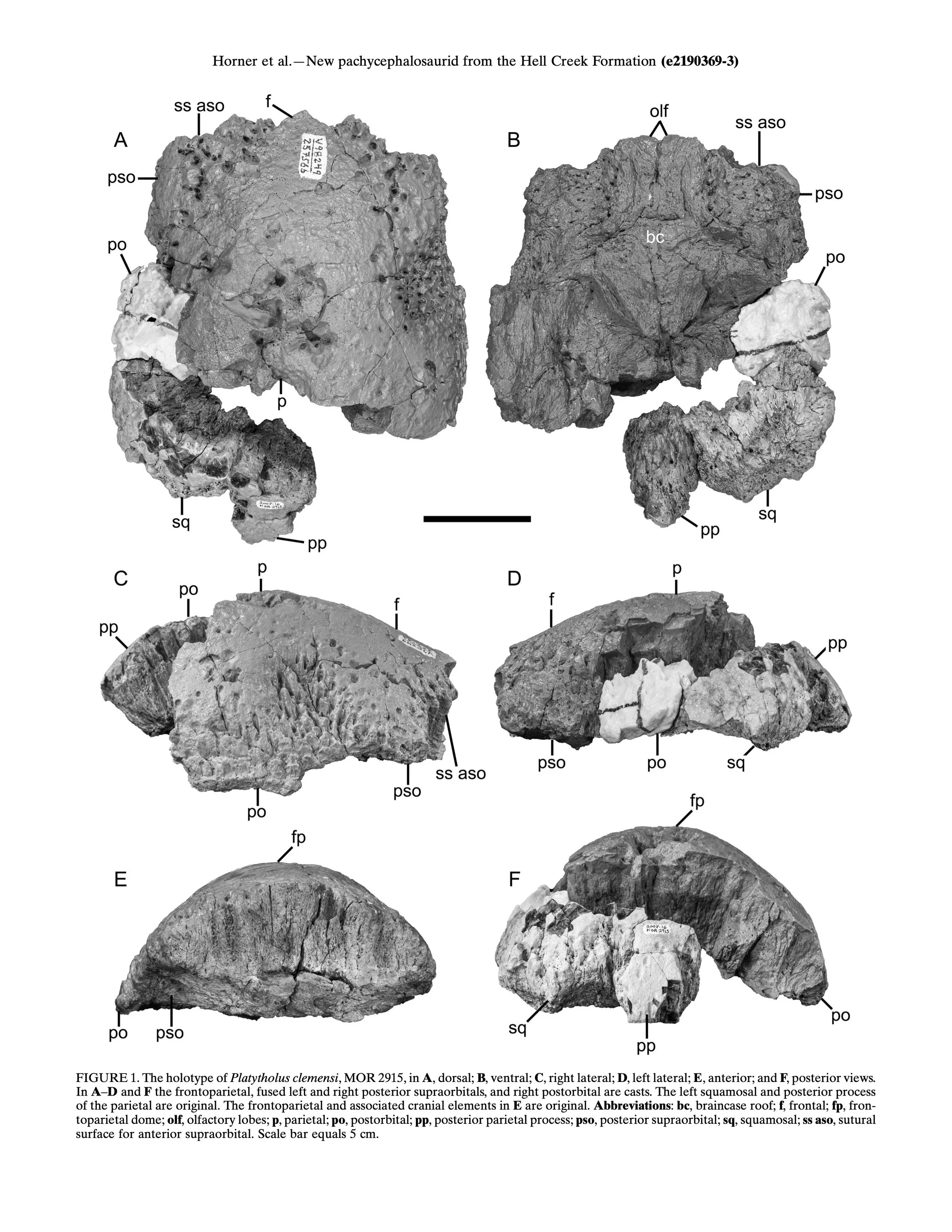
Well, it has a very low, broad dome…
… you know. Like Pachycephalosaurus reinheimeri?
It kinda looks like this is actually a reinheimeri.
So is Platytholus clemensi just a Pachycephalosaurus reinheimeri? Well, possibly.
Another possibility is that reinheimeri is distinct from Pachycephalosaurus- remember that the node arrangement, the rows across the back of the skull, is primitive with respect to both Pachycephalosaurus reinheimeri and Stygimoloch spinifer. So again, it could be a sister-lineage to the Pachycephalosaurus-Stygimoloch clade. In which case, it might deserve its own genus: so perhaps Platytholus reinheimeri?
The Smithsonian Skull
Last, a pachycephalosaur skull from the Hell Creek was recently acquired by the Smithsonian Institution. Although it’s been called Pachycephalosaurus, it’s not actually clear just what it is.
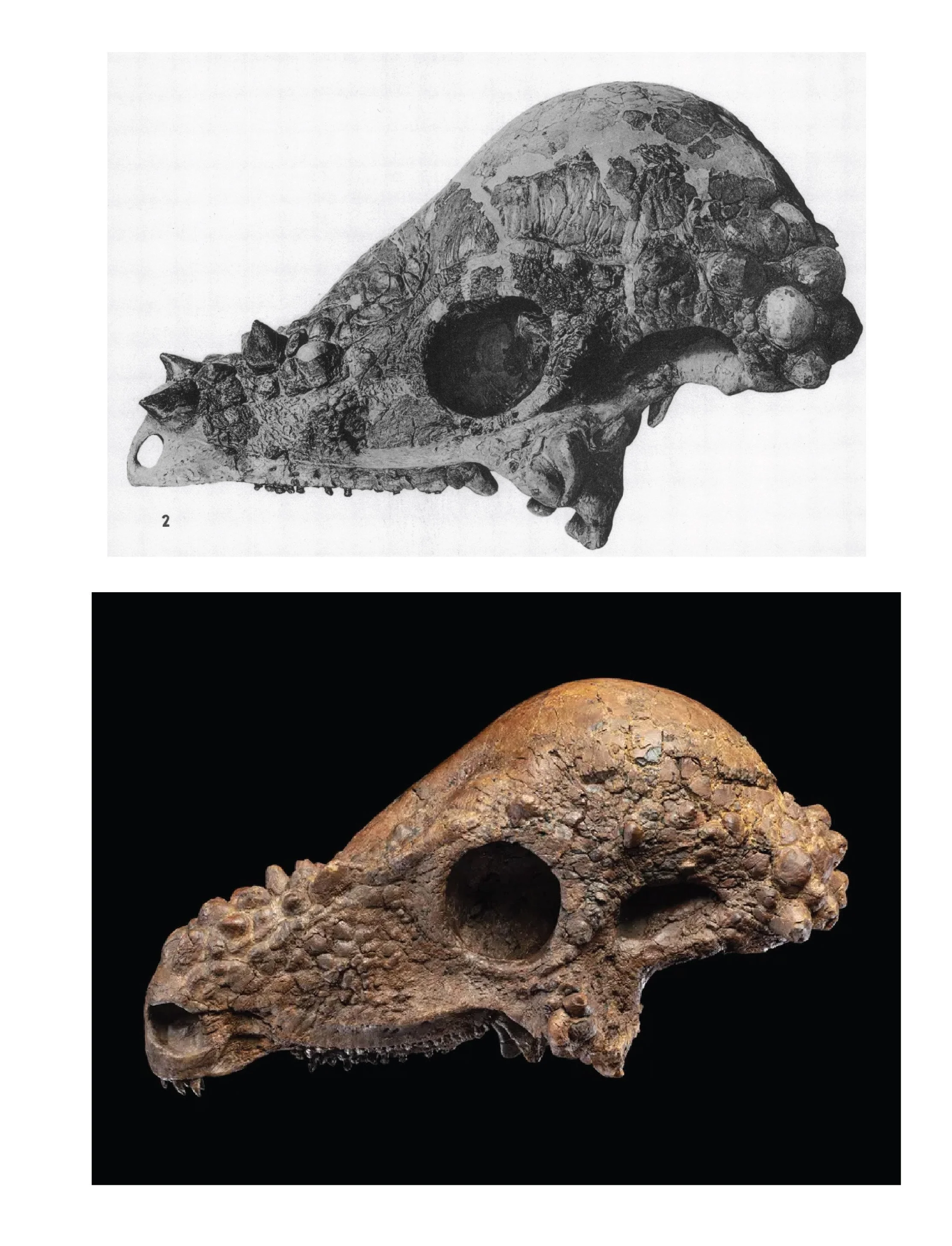
The most striking thing about it is the huge schnozz, which is very unlike the much smaller, more delicate snout of P. wyomingensis. This is actually hugely significant: unlike the ornament (which is at the end of the day, just for show) the snout performs a vital function- feeding. A deeper snout is stronger, with much higher bending resistance, which implies this animal ate much tougher food and had a different diet than the AMNH P. wyomingensis. It’s not a superficial difference, this animal has evolved to exploit a different ecological niche, in the same way that different species of Galapagos finches have different beaks because they occupy different ecological niches.
There is some reconstruction in the P. wyomingensis (and I am told the Smithsonian skull has a fair amount of work done on it too) but it seems hard to believe the radical difference in shape is all just plaster (that being said, careful study obviously needs to be done here).
But there are other differences.
This new skull lacks the rings of big hornlets on the snout seen in Pachycephalosaurus wyomingensis; instead having a large number of smaller nodes.
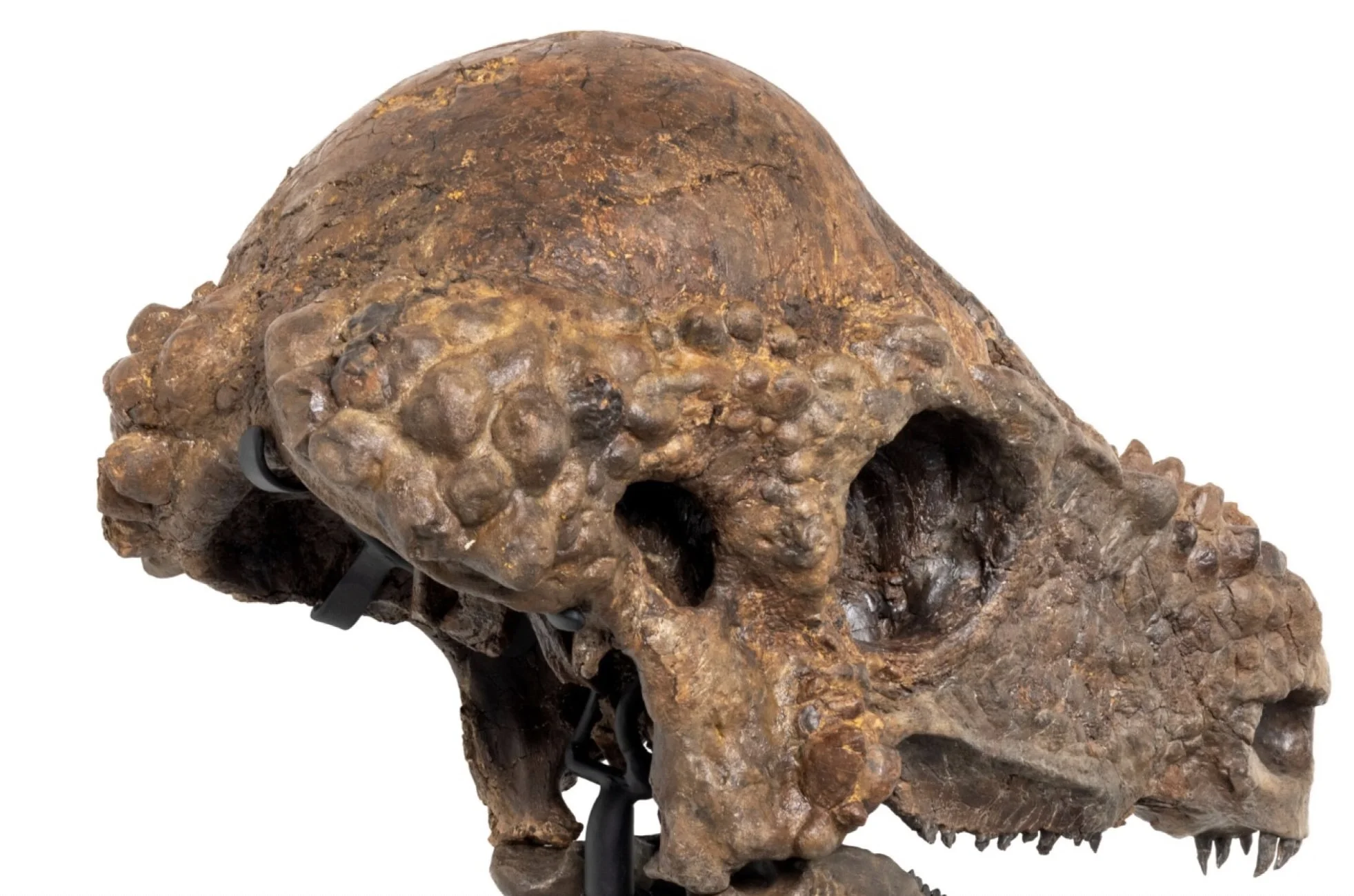
It also seems to have ornament extending across the back of the skull for almost the full width of the skull, with just a narrow notch separating the medial nodes, as in P. reinheimeri. So could it be a P. reinheimeri? Maybe. The dome seems taller, however. So, something different? Maybe. Again, this needs careful study.
Conclusions
Pachycephalosaurs are a curious and mysterious group of animals. It’s remarkable that about 90% or more of their fossil record is just the skulls and domes; if we didn’t have the heads we’d only have a handful of partial skeletons and probably never guess how diverse and successful they were (this tells us something about how biased the fossil record is against small animals: typically its only the nigh-indestructible dome that is preserved of these creatures).
Fortunately, we do have the skulls and domes. These are frustrating to work with at times— ontogeny and/or sexual dimorphism seem to result in a lot of differences in the development of the dome within a single species. The key to pachycephalosaur taxonomy therefore seems to be the ornament, since it reflects scalation, which is more ontogenetically stable. I’m not saying we should ignore the domes entirely, but we should start with the ornament and work from there; that’s the most reliable basis for distinguishing species (an analogous situation exists with the parietosquamosal ornament of ceratopsids).
So how many pachycephalosaurs are there in the late Maastrichtian? It’s unclear. But I would guess:
Pachycephalosaurus wyomingensis,
Stygimoloch spinifer
Pachycephalosaurus(?) reinheimeri,
Sphaerotholus buchholtzae
Smithsonian skull (maybe something new?)
This sounds like a lot, but there are at least four pachycephalosaurs in the Dinosaur Park Formation; these animals also differ in size so there’s a degree of niche partitioning going on between very large (Pachycephalosaurus) medium (Stygimoloch) and small (Sphaerotholus) species. It’s not entirely clear what Platytholus is, but it could be the same thing as P. reinheimeri. Or maybe, given that it’s beat-up, lacks the squamosals, and possibly immature, it should just be declared a nomen dubium and tossed out.
The Smithsonian skull looks distinct from P. wyomingensis. It’s more similar to P. reinheimeri in the ornament, but it could be a distinct species. We also need to consider that the Hell Creek spans a significant amount of time- around a million years- so we may have lineages like Stygimoloch and Pachycephalosaurus with different species in the upper and lower Hell Creek, as we seem to have for Triceratops (and perhaps Tyrannosaurus). This would increase total diversity still further. Obviously, further evidence could change things, resulting in fewer or (I suspect) even more species. We have relatively few good specimens, I seriously doubt we’ve seen everything that was around in the late Maastrichtian, and we have virtually nothing from the Southwest or Canada at this time; the Hell Creek and Lance are the only places that anything approaching decent sampling.
So almost a century after Pachycephalosaurus was first described, we still know very little about these animals; we have a couple skulls, lots of skull fragments, and no complete skeletons for any late Maastrichtian pachycephalosaurs. We are still trying to figure out how they grew, if they were sexually dimorphic, their evolutionary relationships- and just how many species there were. So anyone who tells you we 100% know what is going on with pachycephalosaurs based on this extremely limited and biased sample is, frankly, bullshitting you and does not know what they are talking about. Dinosaur taxonomy is unfortunately a lot less scientific than it looks, and often driven by academic politics rather than careful consideration of the evidence.
That we know so little is both frustrating and encouraging- frustrating that we’re still trying to sort these animals out, but encouraging in that even after a century, there is still a lot of work left to be done to make sense of these animals. The sheer difficulty of paleontology- trying to sort out different species based on a handful of fossils— means we have job security, and interesting problems to look forward to making progress on.
—N
References
Brown, B. & Schlaikjer, E. M. A study of the troödont dinosaurs with a description of a new genus and four new species. Bulletin of the American Museum of Natural History 82, 115-149 (1943).
Gilmore, C. W. A new species of troödont dinosaur from the Lance formation of Wyoming. Proceedings of the United States National Museum 79, 1-6 (1931).
Horner, J. R., Goodwin, M. B. & Evans, D. C. A new pachycephalosaurid from the Hell Creek formation, Garfield County, Montana, USA. Journal of Vertebrate Paleontology 42, e2190369 (2022).
Longrich, N. R., Sankey, J. T. & Tanke, D. H. Texacephale langstoni, a new genus of pachycephalosaurid (Dinosauria: Ornithischia) from the upper Campanian Aguja Formation, southern Texas, USA. Cretaceous Research 31, 274-284 (2010).
Maryanska, T., Chapman, R. E. & Weishampel, D. B. in The Dinosauria (eds David B. Weishampel, Peter Dodson, & Halszka Osmolska) 464-477 (University of California Press, 2004).
Schott, R. K. et al. Cranial Ontogeny in Stegoceras validum (Dinosauria: Pachycephalosauria): A Quantitative Model of Pachycephalosaur Dome Growth and Variation. PLOS One 6, e21092 (2011).
Sues, H. D. & Galton, P. M. Anatomy and classification of the North American Pachycephalosauria (Dinosauria: Ornithischia). Palaeontographica Abteilung 198, 1-40 (1987).
Sullivan, R. M. A taxonomic review of the Pachycephalosauridae (Dinosauria: Ornithischia). New Mexico Museum of Science Bulletin 35, 347-365 (2006).